
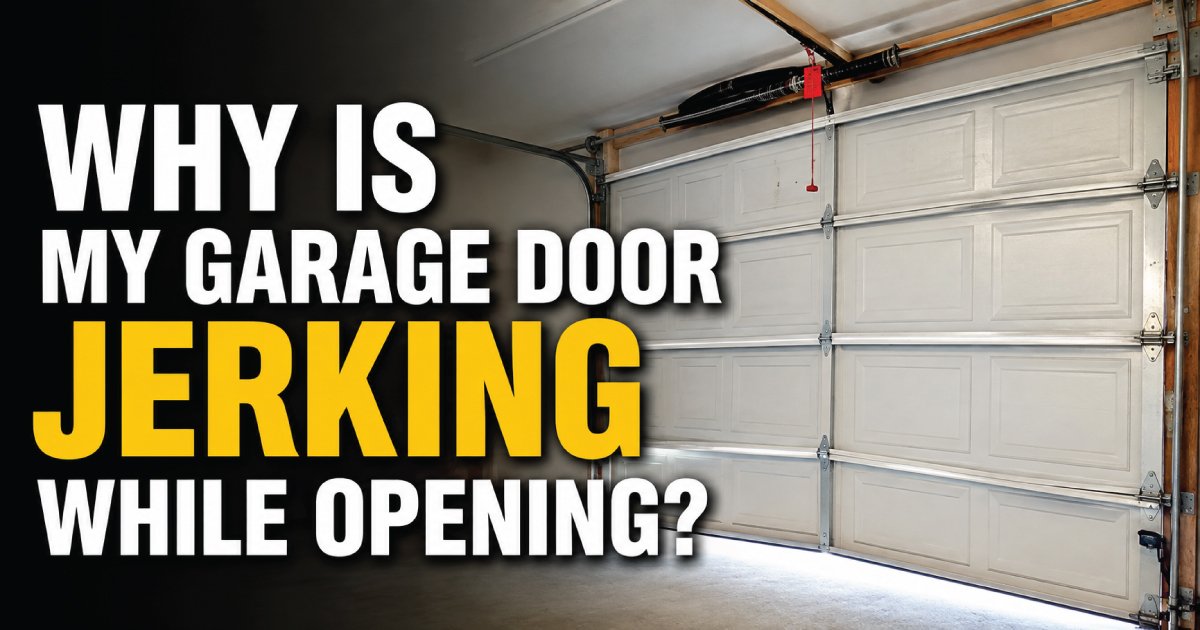
If you are wondering why your garage door is jerking while opening, the problem usually comes from uneven movement somewhere in the door, tracks, rollers, springs, cables, or opener system. A door should rise smoothly with steady movement. Jerking, hesitation, shaking, or stopping briefly can indicate friction, poor balance, worn hardware, or an opener problem. Ignoring the symptom can turn a minor maintenance issue into expensive damage.
This guide explains the most common causes of a jerking garage door and shows you how to diagnose them safely. You will learn what normal operation looks like, which warning signs matter, what you can inspect yourself, and when professional repair is necessary. Because garage doors are heavy and their springs store substantial energy, the troubleshooting process focuses first on safe visual checks and simple observations rather than risky adjustments.
Common Signs and Symptoms
A jerking garage door does not always move in exactly the same way. Some doors shake throughout the opening cycle, while others hesitate at one particular point. Paying attention to when and how the movement occurs can provide valuable clues about the failed component and help narrow down the diagnosis before any repair is attempted.
You may notice one or several of these symptoms:
- Shaking or vibrating: The door visibly shakes as it moves upward.
- Hesitation: The door pauses briefly before continuing to open.
- Sudden jumps: The door rises smoothly and then suddenly moves several inches.
- Jerking at one location: The problem appears at the same point during every opening cycle.
- Grinding or squealing: Unusual sounds accompany the uneven movement.
- Slow opening: The opener struggles to lift the door at a normal speed.
- Uneven panel movement: One side appears to rise slightly before the other.
- Door stops halfway: The opener may stop because it detects excessive resistance.
- Opener motor strains: You may hear the motor working harder than usual.
- Visible roller movement: Rollers may wobble, stick, or jump inside the tracks.
- Cable movement looks abnormal: A cable may appear loose, tangled, or improperly positioned.
- Jerking occurs only when using the opener: This can point toward the opener, although the door itself should still be inspected.
A useful real-world clue is consistency. If the door jerks at exactly the same point every time, inspect that section of the tracks, rollers, hinges, and panels closely. If the entire opening cycle is rough, balance, lubrication, springs, or opener-related problems become more likely.
How the Garage Door Normally Works
A residential sectional garage door moves through a coordinated system of panels, rollers, hinges, tracks, cables, springs, and an automatic opener. The springs counterbalance much of the door’s weight, while the rollers guide the panels along the vertical and horizontal tracks. The opener supplies controlled movement rather than carrying the entire door’s weight.
During normal operation, the door should begin moving without a violent jump and travel upward at a relatively consistent speed. The rollers should move smoothly through the tracks without binding, and the panels should remain properly aligned.
The basic process looks like this:
- The opener receives the command to open.
- The motor turns the drive mechanism.
- The opener pulls the door through its lifting system.
- Springs help counterbalance the door’s weight.
- Rollers travel through the tracks.
- Hinges allow the individual panels to bend as the door changes direction.
- The door reaches the open position and stops at the programmed limit.
If one part creates excessive resistance, another component may have to work harder. For example, a dry roller or bent track can make the opener strain even though the motor itself is functioning correctly.
Most Common Reasons This Problem Happens
A jerking door is usually a mechanical symptom rather than a single specific failure. The most common causes include worn rollers, dirty or damaged tracks, loose hardware, poor lubrication, spring problems, cable issues, door imbalance, and opener-related faults. The location and timing of the jerk can help distinguish between these possibilities.
Worn or Damaged Rollers
Garage door rollers guide the door through its tracks, so damaged rollers can cause noticeable resistance. Plastic rollers may crack or deform with age, while metal rollers can develop worn bearings that no longer rotate smoothly.
Typical signs: rattling, grinding, wobbling rollers, or jerking that becomes worse as the door travels through the horizontal tracks.
How to identify it: Watch the rollers while the door moves. Look for excessive wobbling, flat spots, damaged wheels, or rollers that appear to drag rather than rotate.
Do not remove rollers from their brackets without proper knowledge. Some roller brackets are under significant tension because of the door’s construction.
Dirty, Bent, or Misaligned Tracks
The tracks provide the path for the rollers. Dirt alone does not normally cause severe problems, but bent sections, loose mounting hardware, or track misalignment can create substantial resistance.
Typical signs: The door jerks at the same location, makes scraping noises, or appears to rub against one side of the track.
How to identify it: With the door stationary, visually inspect both tracks. Look for obvious bends, dents, gaps, loose fasteners, or sections that no longer appear parallel.
Never hammer a track back into position while the door is under load. Track alignment repairs can affect the entire door system and may require professional adjustment.
Loose Hinges and Hardware
The hinges connecting garage door sections experience repeated movement. Loose bolts, screws, brackets, or hinges can allow a panel to shift slightly as the door travels.
Typical signs: Clicking sounds, panel movement, or jerking that becomes more noticeable as the door changes from vertical to horizontal travel.
How to identify it: With the door closed and stationary, visually inspect accessible hinges and mounting hardware for obvious looseness or damage.
Simple tightening of accessible hardware may be appropriate if the manufacturer’s instructions permit it, but never remove hardware that supports springs, cables, or other high-tension components.
Insufficient Lubrication
Moving metal components can become noisy and resistant when lubrication is neglected. Hinges, rollers, and certain moving points may require periodic lubrication according to the manufacturer’s recommendations.
Typical signs: Squeaking, squealing, grinding, and progressively rough movement.
How to identify it: Listen carefully during operation. A dry component often produces a repetitive sound that corresponds with each movement.
Use a garage-door-appropriate lubricant rather than a thick household grease that can attract dirt. Avoid spraying lubricant onto the floor, tracks, or safety sensors.
Broken, Weak, or Incorrectly Adjusted Springs
Springs counterbalance the door, making them one of the most important components in smooth operation. A broken or weakened spring can make the opener struggle and may cause jerking or stopping.
Typical signs: The door feels unusually heavy, opens only partway, sits unevenly, or the opener strains significantly.
How to identify it: Look for an obvious broken spring or a visible gap in a torsion spring. Extension-spring systems may show different warning signs.
Safety: Never adjust, remove, stretch, or replace garage door springs as a beginner. Springs store substantial energy and can cause severe injuries if they release unexpectedly.
Cable Problems
Lift cables transfer spring force to the door. A loose, frayed, tangled, or displaced cable can cause uneven lifting and should never be ignored.
Typical signs: One side of the door rises differently, the door hangs crooked, or a cable appears loose or off its drum.
How to identify it: With the door closed, inspect the visible cables without touching them. Look for fraying, broken strands, unusual slack, or a cable that has come off its normal path.
Safety: Do not attempt to reinstall or tension a garage door cable yourself. Cable problems can be connected directly to spring tension and require professional repair.
Garage Door Opener Problems
The opener itself can also cause jerking. A worn drive gear, damaged trolley, incorrect travel settings, excessive friction, or motor-related problem can produce irregular movement.
Typical signs: The door moves smoothly when operated manually but jerks when connected to the opener. You may also hear unusual motor or drive noises.
How to identify it: A qualified person can disconnect the opener according to the manufacturer’s instructions and assess the door’s manual movement. Do not force the door or work around the opener’s internal electrical components.
Safety Precautions Before Troubleshooting
Garage doors can weigh hundreds of pounds, and their springs and cables can store dangerous amounts of energy. Before inspecting anything, keep the door stable and avoid components that carry tension. The safest troubleshooting focuses on observation, cleaning, and basic checks that do not require dismantling the door or opener.
Follow these safety rules:
- Keep children and pets away from the garage during testing.
- Never stand beneath a moving door.
- Keep fingers away from hinges, rollers, tracks, and panel joints.
- Do not remove springs or spring brackets.
- Never adjust spring tension without appropriate training.
- Do not pull or reposition loose cables.
- Never operate the door if a cable is badly frayed or off the drum.
- Disconnect opener power when the manufacturer’s procedure requires it for inspection.
- Never bypass photo-eye safety sensors.
- Stop immediately if you see smoke, sparks, damaged wiring, or burning smells.
- Do not continue cycling a door that appears unstable or partially detached.
- If the door becomes crooked, extremely heavy, or difficult to control, call a qualified garage door technician.
A safe rule is simple: if the repair involves spring tension, cable tension, or major structural hardware, it is not a beginner DIY repair.
Tools Required
Most initial garage door troubleshooting does not require a large toolbox. A flashlight, cloth, and basic inspection tools are enough to identify many visible problems. The purpose of these tools is diagnosis, not dismantling the door. Avoid buying specialized spring or cable tools unless you have professional training for this type of work.
| Tool | Purpose |
|---|---|
| Flashlight | Inspect tracks, rollers, hinges, cables, and hardware |
| Soft cloth | Remove surface dirt from accessible components |
| Screwdriver | Inspect or tighten suitable accessible hardware |
| Wrench or socket set | Check approved accessible fasteners |
| Garage-door lubricant | Lubricate appropriate moving components |
| Step stool | Reach safe, accessible areas without climbing on the door |
| Manufacturer’s manual | Check maintenance and adjustment procedures |
| Safety glasses | Protect eyes during inspection and cleaning |
Step-by-Step Troubleshooting Guide
The safest diagnosis starts with observation and progresses toward more specific checks. Do not begin by adjusting springs or opener settings. Watch the door carefully, identify where the movement changes, and compare what you see with the likely causes. This method helps prevent unnecessary repairs and gives a technician useful information if professional service becomes necessary.
- Watch the entire opening cycle.
Inspect: Stand several feet away and watch the door open.
Why it matters: Note whether the jerk occurs at the beginning, middle, or end.
Expected result: A healthy door should move consistently without sudden jumps.
Next: If the jerk occurs at one location, inspect that section more closely. - Listen for unusual sounds.
Inspect: Listen for grinding, squealing, scraping, clicking, or popping.
Why it matters: Different sounds can point toward rollers, tracks, hinges, or the opener.
Expected result: Normal operation should not produce sudden harsh mechanical noises.
Next: Match the sound with the location of the jerking. - Inspect the tracks visually.
Inspect: Look for dents, bends, loose fasteners, debris, or obvious misalignment.
Why it matters: A roller encountering resistance can make the whole door jump.
Expected result: Tracks should provide a clear path for the rollers.
Next: If damage is visible, avoid forcing the door and arrange professional repair. - Inspect the rollers and hinges.
Inspect: Look for cracked rollers, wobbling wheels, damaged hinges, or loose accessible hardware.
Why it matters: These components guide and articulate the door during movement.
Expected result: Rollers should travel without obvious binding or severe wobbling.
Next: Replace damaged components or have them professionally serviced. - Check for obvious spring or cable damage.
Inspect: Look without touching the springs or cables.
Why it matters: A broken spring or damaged cable can make the door unsafe.
Expected result: Springs and cables should appear intact and properly positioned.
Next: If either looks damaged, stop operating the door and call a professional. - Look for uneven door movement.
Inspect: Watch whether both sides rise together.
Why it matters: Uneven lifting can indicate a cable, spring, roller, or track problem.
Expected result: The door should remain level as it rises.
Next: A noticeably crooked door needs professional diagnosis. - Check whether the problem is mechanical or opener-related.
Inspect: Follow the manufacturer’s safe procedure for disconnecting the opener if you are qualified to do so.
Why it matters: A door that moves smoothly manually but jerks under power points toward the opener.
Expected result: Manual movement should be controlled and reasonably smooth.
Next: If the opener is the likely cause, avoid opening its electrical housing and seek further diagnosis.
Quick Diagnosis Table
The following table provides a fast way to connect the most noticeable symptom with a likely cause. It is a starting point rather than a substitute for inspection because several problems can produce similar behavior. When the door shows signs of spring, cable, or structural damage, safety should take priority over further troubleshooting.
| Symptom | Possible Cause | Recommended Solution |
|---|---|---|
| Jerks at the same point | Bent track or damaged roller | Inspect the affected track section and roller |
| Jerks throughout opening | Poor balance, worn rollers, or opener issue | Inspect door hardware and arrange professional diagnosis if needed |
| Jerking with grinding noise | Worn roller or bearing | Inspect rollers and have damaged parts replaced |
| Jerking with squealing | Dry hinges or rollers | Lubricate approved moving components |
| One side rises unevenly | Cable or spring problem | Stop using the door and call a professional |
| Door feels unusually heavy | Broken or weak spring | Do not operate repeatedly; seek professional repair |
| Door jerks only with opener | Opener or drive-system problem | Have the opener and door system inspected |
| Door scrapes against track | Track alignment or roller issue | Stop forcing the door and arrange inspection |
| Door stops while jerking | Excessive resistance or opener safety detection | Inspect for mechanical obstruction and seek diagnosis |
| Visible frayed cable | Cable failure | Stop operating the door and call a garage door professional |
| Broken spring visible | Spring failure | Do not attempt DIY spring repair |
| Jerking started after impact | Bent panel, track, or hardware | Inspect for structural damage before further use |
How to Fix Each Common Cause
Once you know where the jerking occurs, the repair becomes much more straightforward. Some problems, such as cleaning debris or applying the correct lubricant, are reasonable DIY tasks. Others involve springs, cables, structural alignment, or opener components and should be handled by a trained technician. The safest approach is to repair only the component you can identify confidently.
Clean and Lubricate the Moving Components
If the garage door makes squeaking or grinding noises while jerking, lubrication may reduce friction. With the door closed and the opener disconnected only if the manufacturer’s instructions call for it, inspect accessible hinges, roller bearings, and other approved moving points.
Use a garage-door-specific spray lubricant in small amounts. Do not coat the tracks heavily. Rollers need to travel through the tracks, but the track surface itself generally does not need to be greasy.
After lubrication, operate the door several times and listen for changes. If the door still jerks at exactly the same location, lubrication was probably not the complete solution.
Replace Worn Rollers
Worn rollers are a common reason for rough garage door movement. If a roller wheel is cracked, badly worn, wobbling, or its bearing makes a grinding sound, replacement can restore smoother travel.
Safety matters here because some roller brackets can be associated with significant door tension. The top roller brackets on many sectional doors can be especially risky to remove because of their position and geometry.
If you are not experienced with garage door hardware, have a technician replace the rollers. A professional can also inspect the tracks at the same time and determine whether both issues contributed to the jerking.
Correct Track Problems
A track should guide the rollers without forcing them sideways. If a track is bent or displaced, the roller can bind at one point and cause the door to jump.
Do not use a hammer to straighten a track while the door is installed. Track position affects the entire lifting system, and moving it incorrectly can create additional stress.
Minor debris can be removed from accessible areas, but significant bends, crushed sections, or mounting problems should be professionally corrected. A technician can align the tracks without compromising the door’s balance.
Tighten Suitable Loose Hardware
Vibration from thousands of opening cycles can gradually loosen accessible nuts and bolts. Loose hinges or brackets can allow panels to shift as the door moves.
With the door closed and stable, inspect accessible hardware for obvious looseness. Tighten only hardware that is clearly intended for ordinary maintenance and does not support spring tension or cable tension.
Never loosen a bracket simply to see what is behind it. If a fastener is attached to a spring bracket, cable assembly, lifting mechanism, or structural support under load, stop and call a professional.
Repair Spring Problems Professionally
A broken or weakened spring is not a normal DIY adjustment. The spring system is responsible for counterbalancing the door, so improper adjustment can cause the door to become dangerously heavy or move unpredictably.
If you find a broken torsion spring, a separated spring, or obvious damage to an extension-spring system, stop operating the door.
A technician will normally inspect spring condition, door weight, shaft components, cables, drums, and balance before installing the correct replacement. Simply installing a spring that looks similar is not enough; spring dimensions and capacity must match the door system.
Repair Damaged Cables Professionally
A garage door cable should remain properly seated on its drum and should not show significant fraying. If a cable has slipped, broken, or become loose, do not try to pull it back into place.
Cable problems can develop alongside spring or drum problems. Moving the door while a cable is damaged can make the situation worse and may allow the door to become crooked or unstable.
A professional repair should include inspection of both cables and the associated lifting hardware rather than replacing only the visibly damaged section.
Repair or Replace Opener Components
If the door moves smoothly by itself but jerks when powered by the opener, the opener may be contributing to the problem. Possible causes include a worn drive gear, damaged trolley, chain or belt problems, incorrect travel settings, or mechanical wear inside the drive system.
Do not immediately adjust force settings to make a struggling door continue operating. Increasing opener force can mask an underlying mechanical problem and may create a safety issue.
A technician can determine whether the opener needs adjustment, a replacement part, or complete replacement.
Advanced Troubleshooting
When basic inspection does not reveal the cause, advanced diagnosis focuses on separating door resistance from opener malfunction. A garage door can jerk because the opener is reacting to excessive mechanical load, or the opener itself can create uneven movement. Identifying which system is responsible prevents unnecessary replacement.
Check Door Balance Carefully
A properly balanced garage door should not feel extremely heavy when its lifting system is functioning correctly. Balance testing can provide valuable information, but it must be performed according to the opener and door manufacturer’s instructions.
A door that rapidly falls, rises unexpectedly, or becomes difficult to hold in position may have a spring or balance problem.
Do not compensate for poor balance by increasing opener force. The opener is designed to move a properly functioning door, not to substitute for a failed counterbalance system.
Look for a Repeating Travel Pattern
Pay attention to whether the jerk occurs at exactly the same height during every cycle.
A repeating point often suggests a mechanical issue at that location. For example, a damaged roller, bent track, loose hinge, or panel problem may create resistance every time the affected section reaches the same position.
If the jerk occurs at random points, an opener, electrical, or intermittent hardware issue becomes more plausible.
Inspect the Door Panels
A damaged or warped panel can interfere with normal movement. This may happen after a vehicle impact, strong wind, or years of wear.
Look along the panel edges and joints for bends, cracks, separation, or areas where one section does not line up correctly.
Do not attempt to straighten a badly damaged panel while it remains connected to the complete door system. Panel alignment affects rollers, hinges, and tracks, so professional assessment may be necessary.
Consider Opener Travel and Force Settings
Modern openers use travel limits and force monitoring to control movement. Incorrect settings can sometimes cause unusual stopping or movement behavior, particularly after an opener installation, repair, or reset.
However, force settings should not be increased simply because the door jerks. Excessive force can hide mechanical resistance rather than fix it.
Use the manufacturer’s procedure to check settings, and if the opener repeatedly reverses or stops despite a mechanically sound door, arrange professional diagnosis.
Check for Electrical Symptoms
Electrical problems are less common than mechanical causes, but they should not be overlooked. An opener that flickers, resets, makes unusual electrical noises, or behaves inconsistently may have a power or control problem.
If you see damaged wiring, smell burning insulation, notice sparks, or repeatedly trip a circuit breaker, stop testing the opener.
Electrical diagnosis inside the opener should be performed by someone qualified to work safely with the equipment.
When Repair Is Not Worth It
Repair is not always the best financial decision. A garage door can develop several worn components at the same time, particularly when it has been operating for many years. If repeated repairs approach the cost of a new system, replacement may provide better long-term reliability.
Replacement becomes more reasonable when:
- The opener has repeated major failures.
- Multiple structural door components are badly worn.
- The door panels have severe damage or corrosion.
- The repair requires several expensive components at once.
- Replacement parts for an old opener are difficult to obtain.
- The existing opener lacks features you now need.
- Repair costs approach the price of a suitable new system.
- The door itself is near the end of its practical service life.
However, a single worn roller, hinge, or cable does not normally justify replacing the entire garage door. A professional inspection can help separate an isolated repair from a system-wide replacement decision.
Preventive Maintenance Tips
Regular maintenance can prevent many causes of jerking before they become serious. Garage doors perform thousands of cycles over their service life, so small amounts of wear gradually accumulate. A short inspection every few months can reveal loose hardware, damaged rollers, poor lubrication, or other warning signs before the door becomes difficult to operate.
Use these preventive maintenance habits:
- Inspect rollers periodically for cracks, wobbling, or excessive wear.
- Look along tracks for obvious dents or obstructions.
- Keep the garage door area free from objects that could interfere with movement.
- Lubricate approved moving components according to the manufacturer’s recommendations.
- Inspect visible hinges for damage or excessive looseness.
- Watch for changes in door speed or balance.
- Listen for new grinding, scraping, popping, or squealing noises.
- Test the opener’s safety reversal system according to the manufacturer’s instructions.
- Keep photo-eye sensors clean and properly aligned.
- Inspect visible cables without touching or repositioning them.
- Address unusual movement early rather than waiting for complete failure.
- Schedule professional maintenance when the door shows signs of spring, cable, or structural problems.
Preventive maintenance is especially useful for older doors because components may wear gradually without producing an obvious failure until the system is heavily stressed.
Common Mistakes to Avoid
Many garage door problems become more complicated because homeowners try to correct the symptom instead of identifying the underlying cause. A jerking door is often telling you that resistance exists somewhere in the system. Making the opener work harder can conceal that warning instead of solving it.
Avoid these mistakes:
- Increasing opener force immediately: This can hide mechanical resistance and create additional safety concerns.
- Straightening tracks with force: A track can be damaged further if moved without understanding its alignment.
- Lubricating the entire track: Excess lubricant attracts dirt and does not necessarily solve roller or alignment problems.
- Pulling on loose cables: A cable may be connected to a high-tension system.
- Adjusting springs without training: Spring tension is one of the most dangerous parts of garage door repair.
- Continuing to operate a crooked door: Repeated cycling can damage additional components.
- Ignoring unusual noises: New grinding or popping sounds often appear before mechanical failure.
- Replacing the opener first: A worn roller or damaged track can make a perfectly good opener appear faulty.
- Standing beneath the door during testing: A heavy door can move unexpectedly if a component fails.
- Bypassing safety sensors: Safety systems should never be disabled to keep a faulty door operating.
When to Call a Professional
A professional repair is appropriate whenever the problem involves stored mechanical energy, major structural alignment, or electrical components. Knowing when to stop a DIY inspection is not a failure; it is part of responsible garage door maintenance. Springs and cables can release energy suddenly, while an improperly balanced door can become unstable.
Call a qualified garage door technician if:
- A torsion or extension spring is broken.
- A cable is frayed, broken, or off its drum.
- The door is visibly crooked.
- The door is extremely heavy when moving.
- A roller bracket or spring bracket appears damaged.
- Tracks are severely bent or displaced.
- The door has been hit by a vehicle.
- The opener motor strains or repeatedly stops.
- Electrical wiring is damaged.
- The opener repeatedly trips a breaker.
- The door jerks severely despite basic maintenance.
- You cannot determine whether the problem is mechanical or electrical.
A professional can also perform a complete balance and safety inspection rather than addressing only the symptom.
Estimated Repair Costs
Garage door repair prices vary considerably depending on location, door size, component quality, labor rates, and the extent of damage. The figures below are broad planning estimates rather than fixed prices. Always obtain a local quote before approving major work, particularly when several components need replacement.
| Repair | Estimated Cost | DIY or Professional |
|---|---|---|
| Basic lubrication and inspection | $0–$50 | DIY / Professional |
| Minor accessible hardware tightening | $0–$75 | DIY / Professional |
| Roller replacement | $100–$300 | Professional recommended |
| Hinge replacement | $100–$250 | DIY / Professional depending on location |
| Track adjustment | $100–$250 | Professional |
| Track replacement | $150–$400+ | Professional |
| Garage door spring replacement | $200–$500+ | Professional |
| Cable repair or replacement | $150–$350+ | Professional |
| Opener repair | $100–$300+ | Professional |
| New garage door opener | $300–$800+ installed | Professional recommended |
| Major panel replacement | $300–$1,000+ | Professional |
Local prices can be substantially different, and premium doors or unusual opener systems may cost more.
Frequently Asked Questions
Why is my garage door jerking while opening?
A garage door usually jerks while opening because of excessive mechanical resistance, worn rollers, damaged tracks, loose hardware, spring problems, cable issues, or an opener fault. The location of the jerking is an important clue. If it happens at the same point every time, inspect that section for track, roller, hinge, or panel problems before assuming the opener has failed.
Can a dirty garage door track cause jerking?
A dirty track can contribute to rough movement, but severe jerking is more often associated with track damage, misalignment, or a roller problem. Remove obvious debris from accessible areas and observe the door again. Do not heavily lubricate the track surface, because grease can collect dirt and may make the underlying problem harder to diagnose.
Is it safe to keep using a jerking garage door?
It is not always safe to keep operating a garage door that jerks severely, especially when the movement is accompanied by a crooked door, damaged cable, broken spring, or loud mechanical noise. Repeated operation can increase damage. If the door becomes unstable, unusually heavy, or visibly damaged, stop using it and arrange professional inspection.
Why does my garage door jerk at the same spot every time?
Jerking at the same spot usually indicates resistance associated with a particular section of the door’s travel. A bent track, damaged roller, loose hinge, warped panel, or other local mechanical problem can cause this pattern. Carefully observe the affected area while the door is stationary and avoid forcing the door if you see structural damage.
Can worn rollers make a garage door jerk?
Yes, worn rollers can make a garage door jerk, particularly when their wheels crack, wobble, bind, or their bearings become rough. You may also hear grinding or rattling. Inspect the rollers visually without removing them. Because certain roller brackets can involve hazardous door tension, professional replacement is recommended when you are not experienced with garage door hardware.
Can a broken spring make a garage door jerk?
Yes, a broken or severely weakened spring can make a garage door jerk because the opener must deal with a door that is no longer properly counterbalanced. Other warning signs include unusual heaviness, uneven movement, or difficulty opening. Never adjust or replace a garage door spring yourself unless you have professional training and the correct equipment.
Why does my garage door jerk only when using the opener?
If the door moves smoothly when operated correctly by hand but jerks when powered, the opener may have a drive, trolley, travel-setting, or force-related problem. However, the door’s mechanical system should still be inspected first. An opener can struggle because of excessive resistance from rollers, tracks, springs, or other hardware rather than because the motor itself is defective.
Should I lubricate my garage door tracks to stop jerking?
No, heavily lubricating garage door tracks is generally not the right solution for jerking. The rollers need to travel through the tracks, but coating the track surface with grease can attract dirt and debris. Instead, identify whether the rollers, hinges, bearings, or track alignment are causing resistance and lubricate only components recommended by the manufacturer.
How often should I maintain my garage door?
A garage door benefits from regular visual inspection and periodic professional maintenance, especially when it is used frequently. Check for unusual sounds, jerking, damaged rollers, loose hardware, and visible cable or spring problems several times a year. Follow the manufacturer’s maintenance recommendations for lubrication, safety testing, and component inspection rather than relying on a fixed schedule alone.
Final Thoughts
If you are asking why your garage door is jerking while opening, do not assume the opener is automatically the problem. In many cases, the real cause is mechanical: worn rollers, damaged tracks, loose hinges, poor lubrication, spring problems, cable issues, or a door that has become difficult to move correctly. Watching exactly when the jerking happens can provide one of the most useful clues.
Start with safe visual inspection and listen carefully for changes in sound. Look for obvious track damage, roller wear, loose hardware, uneven movement, and visible spring or cable problems. Simple cleaning and manufacturer-approved lubrication may help with minor friction, but do not attempt spring or cable repairs without professional training.
If the door becomes crooked, unusually heavy, unstable, or severely noisy, stop operating it. Continuing to cycle a damaged garage door can turn one failed component into several.
Good preventive maintenance also makes a difference. Regular inspection, timely lubrication of approved components, and prompt attention to unusual movement can extend the life of both the garage door and opener. When the repair involves high-tension parts or electrical components, professional service is the safer and usually more economical choice.

Engineer Ali Hasan is a garage door expert and the founder of FixFasty. With over 16 years of experience in mechanical systems and home maintenance, he provides practical, step-by-step guides on garage door installation, repairs, and maintenance, helping homeowners keep their garage doors safe, reliable, and long-lasting.