
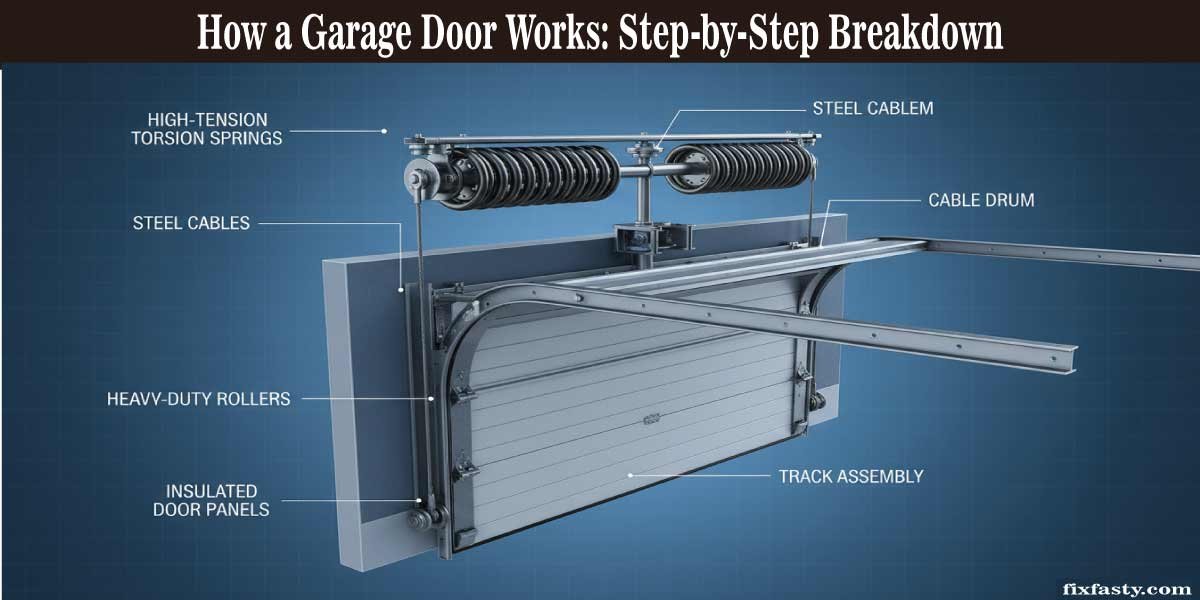
The Main Parts of a Garage Door System
Before understanding how a garage door works step by step it is important to know the components involved. A garage door system has parts that work together to lift, guide and safely operate a heavy door. When all components work properly the garage door moves smoothly and safely. If one part gets worn or damaged it can affect how well the door works, its safety and its reliability.
1. Door Panels or Sections
The door panels, also called sections make up the body of the garage door and give it structure and appearance. These panels are connected with hinges, which allow the door to bend and follow the track as it opens and closes. If the panels get damaged or misaligned it can affect how smoothly the door moves and its overall safety.
2. Tracks and Rollers
The tracks provide a path for the garage door while the rollers help it move smoothly along that path. Together they make sure the door operates quietly and evenly during opening and closing. If the tracks get bent the rollers wear out or there is a lack of lubrication it can cause jerky movement, noise or the door coming off track.
3. Springs (Torsion or Extension)
The springs are very important because they counterbalance the weight of the garage door. Torsion springs are mounted above the door while extension springs run along the sides. They store energy to help lift and lower the garage door safely. If the springs break or wear out the door can become extremely dangerous.
4. Cables and Drums
The cables and drums work closely with the springs to control the garage doors movement. The cables carry tension. Guide the door as it lifts and lowers while the drums help wind and unwind the cables evenly. If the cables get frayed or loose it can cause movement or sudden door failure.
5. Garage Door Opener
The garage door opener is the motorized system that automatically opens and closes the garage door using a control or wall switch. It connects to the garage door through a mechanism and provides convenience and security. If the opener malfunctions it can cause movement or failure to stop properly.
6. Safety Sensors
The safety sensors are located near the bottom of the door tracks. Protect people, pets and property. They detect objects in the garage doors path. Stop or reverse the door if something is detected. If the sensors get dirty, misaligned or faulty they reduce protection. Increase the risk of accidents.
7. Brackets
The hinges and brackets hold the garage door sections together. Support the doors movement along the tracks. They help maintain alignment and stability during operation. If the hinges and brackets get loose cracked or worn it can cause shaking, uneven motion and added stress on components.
Each part plays a role in the garage door system and when one fails or is neglected the entire system can be affected. The garage door system relies on all its parts to work properly. If one part fails it can cause problems, with the system. Regular maintenance of the garage door system is essential to ensure it works smoothly and safely.
👉 Learn about essential garage door parts with this complete guide. Understand how springs, cables, rollers, tracks, and openers work together for safe operation. Read the full post to maintain, repair, and extend the life of your garage door.
Step 1: The Garage Door Opener Receives the Signal
When you press the wall button or use the control or smartphone app that is connected to your garage door system it sends a signal to the opener. This signal tells the opener to start working. The opener gets the signal. Figures out if the garage door should open or close.
The garage door opener uses a kind of technology that changes the code every time you use the remote. This helps keep your garage safe from people who are not supposed to be.
Once the opener knows it is okay to open or close the garage door it turns on the motor. The motor works with the springs and cables to lift or lower the garage door safely.
Step 2: The Opener Motor Starts Moving
The motor in the garage door opener gives the power needed to move the garage door. The motor works with one of a different mechanisms to move the door.
A chain: A metal chain pulls the door along the track. Chain drives are strong and reliable but tend to be noisier during operation.
A belt: A reinforced rubber or steel-reinforced belt moves the door smoothly and quietly, making it ideal for attached garages.
A screw drive: A threaded steel rod rotates to move the door, require fewer moving parts and less maintenance in moderate climates.
The motor does not lift the weight of the garage door by itself. Instead it works with the springs to counterbalance the weight of the door. This helps the motor move the door safely without much strain.
Step 3: Springs Do the Heavy Lifting
Garage door springs are an important part of the system. They help counterbalance the weight of the door so it can be. Lowered smoothly.
There are two main types of garage door springs:
Torsion Springs
Mounted above the garage door opening
Use twisting force to lift the door
More durable and controlled
Extension Springs
Located along the sides of the door
Stretch and contract to move the door
More common in older systems
Without properly function springs, a garage door would be nearly impossible to lift.
Step 4: Cables and Drums Assist with Balance
Step 5: Rollers Move Along the Tracks
As the garage door opens and closes the rollers and tracks play a role in controlling its movement. The tracks provide a path for the door to follow. The rollers help guide the door as it moves.
Move smoothly: Rollers reduce friction as the door travels along the tracks, allow steady and controlled movement. Worn or damaged rollers can cause shake, grinding type noises, or jerky motion that puts extra stress on the entire system.
Stay aligned: Properly function rollers keep the garage door centered within the tracks. This alignment prevents the door from rubbing against the frame, popping off track, or become uneven, which could lead to safety risks or mechanical failure.
Transition from vertical to horizontal: As the door opens, rollers help guide it smoothly from the vertical position to the horizontal position near the ceiling. This transition requires precise alignment to prevent binding, sticking, or sudden movement.
Well-lubricated rollers reduce noise, minimize wear on tracks and hardware, and extend the overall lifespan.
Step 6: The Door Panels Bend and Travel Overhead
For garage doors the individual panels are connected with hinges that allow them to pivot as the door moves. As the door opens the hinges let the panels bend smoothly and follow the path of the tracks.
Once the door is fully open the panels rest horizontally along the garage ceiling out of the way. This design helps maximize space inside the garage and allows for access.
Step 7: Safety Sensors Monitor the Door’s Path
Modern garage doors have safety sensors mounted near the bottom of the tracks. These sensors send out a beam across the garage opening to detect objects, people or pets in the door’s path.
If the beam is interrupted while the door is closing, the system. Reverses direction. This feature helps prevent accidents and protects people, pets and property.
Step 8: The Door Fully Opens or Closes
When the garage door reaches its fully open or fully closed position the opener’s motor stops automatically. This is controlled by limit switches, inside the opener that signal the motor to halt movement once the door reaches its endpoint.
At this point the opening or closing cycle is complete. The door stays in place until the time you use the wall button, remote control or smartphone app to activate the system.
Key Garage Door Parts and Their Functions
| Component | Purpose | Why It Matters |
|---|---|---|
| Springs | Counterbalance door weight | Enables safe lifting |
| Opener motor | Powers movement | Controls opening/closing |
| Cables | Support door weight | Prevents sudden falls |
| Rollers | Guide door along tracks | Ensures smooth movement |
| Tracks | Keep door aligned | Prevents derailment |
👉 Explore different garage door types and learn how to choose the best for your home. Discover options, materials, and styles to match your needs, improve security, and enhance curb appeal. Read the full guide now!
How Manual Garage Doors Work
Not all garage doors have openers. Manual garage doors use parts like springs, tracks, rollers and hinges to lift and lower the door safely. Knowing how these parts work helps homeowners use the door correctly and know when it needs maintenance or repairs.
1- Springs make the door lighter:
Manual doors use springs that help balance the doors weight. These springs make it easy to lift and lower the door. If the springs are worn or broken the door may feel very heavy or unsafe to use.
2- Rollers help the door move:
Rollers move along metal tracks on either side of the door keeping it aligned and moving smoothly. Good rollers reduce friction. Prevent the door from sticking or wobbling making it safe to open and close the door manually.
3- Hinges help the door panels move:
Hinges connect the door panels allowing them to bend as the door moves along the tracks. This helps the door move from vertical to positions smoothly. Damaged or loose hinges can cause the door to move unevenly.
4- Heavy doors can mean spring problems:
If a manual garage door feels very heavy or hard to lift it often means the springs are worn, broken or not balanced correctly. Trying to force the door without fixing the springs can be dangerous. Should be done by a professional.
What Happens When You Close the Garage Door
Closing a garage door is like opening it. In reverse. The door goes down smoothly while the springs unwind to balance the weight. Steel cables guide the door down rollers keep it aligned and safety sensors make sure the path is clear. A working door closes smoothly quietly and safely every time.
Common Garage Door Problems Explained
Knowing how garage doors work helps homeowners find problems early before they get serious. Finding signs, like noises, slow movement or misalignment allows for quick maintenance or repairs preventing accidents reducing repair costs and ensuring the door works safely and reliably.
Typical Issues
Door won’t open: Broken spring or opener issue
Door closes then reverses: Sensor misalignment
Loud noises: Worn rollers or lack of lubrication
Uneven movement: Cable or track problems
Early detection helps prevent costly repairs.
Garage Door Symptoms and Possible Causes
| Symptom | Likely Cause | Recommended Action |
|---|---|---|
| Door feels heavy | Broken spring | Call a professional |
| Door won’t close | Sensor blocked | Clean or realign |
| Grinding noise | Worn rollers | Replace rollers |
| Door jerks | Loose hardware | Tighten components |
| Door stops midway | Opener limits | Adjust settings |
A garage door that is properly balanced will stay steady when it is stopped at any point like when it’s halfway open. This balance is important because it reduces the strain on the opener and the springs. It also makes sure the door works smoothly and does not suddenly fall. This protects people and property from getting hurt.
The opener motor
The springs and cables
The overall structure of the door
An unbalanced door puts extra strain on the opener and increases the risk of sudden failure.
Why You Should Avoid DIY Repairs
You should not try to fix your garage door by yourself. Knowing how garage doors work is useful. Trying to fix parts like springs, cables or openers without the right training can be very dangerous.
High-Risk Components
Springs
Cables
Drums
These parts are under extreme tension. One mistake can cause serious injury. Always call a trained garage door technician for major repairs.
How Regular Maintenance Keeps Garage Doors Working Properly
To keep your garage door working you need to do regular maintenance. This means checking the door lubricating the parts and making adjustments. This will make sure the door works smoothly and prevent it from breaking down. It will also make the door longer.
Basic maintenance includes:
Lubricate rollers, hinges, and springs
Check sensor alignment
Tighten loose bolts
Testing balance and auto-reverse
Small efforts can prevent major failures.
Final Thoughts
In the end garage doors may seem simple. They are actually made up of many parts that work together like springs, cables, rollers and sensors. If you understand how these parts work you can spot problems early. Fix them before they become big issues. You can also make sure the door is safe and reliable and that it will last a time. This will keep your family and property safe.

Engineer Ali Usman is a professional garage door expert and author at FixFasty, with over 10 years of hands-on experience in garage door systems and mechanical maintenance. He writes clear, step-by-step guides on garage door repairs, parts, and safety practices, helping homeowners fix problems correctly and maintain smooth, secure, and long-lasting garage door performance.