
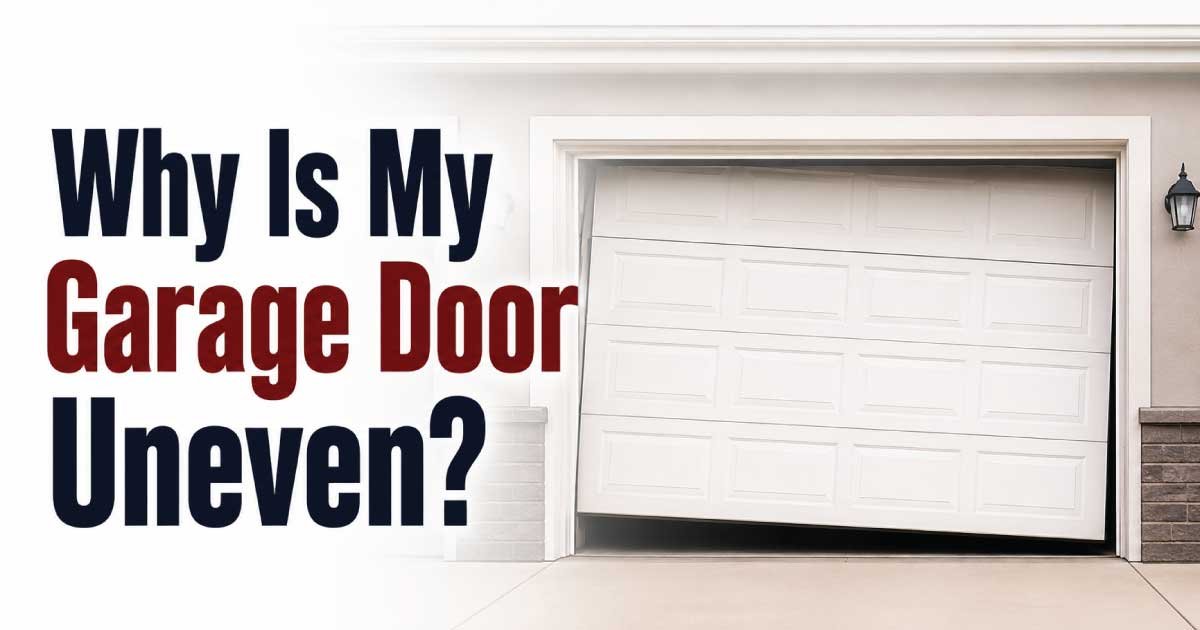
A garage door should open and close smoothly while staying level from one side to the other. If one side hangs lower, moves faster, or refuses to close evenly, something within the door’s lifting system is no longer working as intended. An uneven garage door is more than a cosmetic issue. It can place extra stress on springs, cables, rollers, tracks, and the garage door opener, increasing the risk of expensive damage or sudden failure.
In many cases, the problem starts with normal wear and tear. Aging torsion springs, stretched cables, loose hardware, bent tracks, or damaged rollers can all cause the door to become unbalanced. Sometimes the issue develops gradually, while other times it appears after the door hits an object or one of the lifting components breaks.
This guide explains why your garage door is uneven, how the lifting system normally works, the most common causes of the problem, and how to troubleshoot it safely. You’ll also learn how to recognize warning signs early, determine whether a repair is suitable for DIY work or requires a professional, and avoid making the problem worse during inspection.
Common Signs and Symptoms
An uneven garage door often shows several warning signs before it completely stops working. Recognizing these symptoms early can prevent additional damage and reduce repair costs. Even a small difference in height between both sides of the door can indicate that an important component needs attention.
Common symptoms include:
- One side of the garage door sits lower than the other.
- The door appears crooked while opening or closing.
- One corner touches the ground before the other.
- The garage door jerks or shakes during operation.
- The opener struggles to lift the door.
- Grinding, popping, squeaking, or scraping noises occur.
- Gaps appear between the bottom seal and the floor.
- The door moves unevenly along the tracks.
- Rollers come close to leaving the track.
- The garage door reverses before fully closing.
- The door feels unusually heavy when operated manually.
- Cables appear loose or uneven on each side.
- One spring looks stretched, broken, or damaged.
- The door occasionally becomes stuck halfway.
For example, imagine closing your garage door and noticing that the left side reaches the floor first while the right side remains two inches above it. This usually points to a cable, spring, or track problem rather than an issue with the opener itself.
Ignoring these warning signs can lead to:
- Broken rollers
- Bent tracks
- Damaged garage door panels
- Premature opener wear
- Snapped lift cables
- Complete spring failure
Addressing the issue early is usually simpler and less expensive than waiting for a major component to fail.
How the Appliance or System Normally Works
Understanding how a garage door works makes it much easier to diagnose why it becomes uneven. Although garage doors appear simple, several parts work together to keep the door balanced throughout its travel.
A typical residential garage door includes:
- Torsion or extension springs
- Lift cables
- Cable drums
- Rollers
- Vertical and horizontal tracks
- Hinges
- Garage door opener
- Bottom brackets
Here’s how the system normally operates:
- The opener begins lifting the door.
- The springs carry most of the door’s weight.
- Lift cables wind evenly around the drums.
- Both sides rise at the same speed.
- Rollers travel smoothly inside the tracks.
- Hinges allow door sections to bend as they move overhead.
- The opener guides movement rather than lifting the full weight.
A properly balanced garage door should remain nearly level during the entire opening and closing cycle.
One simple test is to disconnect the opener using the emergency release cord after ensuring the door is fully closed. Lift the door halfway by hand. A balanced door should stay in place with very little movement. If it quickly falls or rises, the spring system likely needs adjustment or replacement.
Understanding this balance helps homeowners realize that an uneven door is usually caused by a mechanical issue rather than a faulty garage door opener alone.
Most Common Reasons This Problem Happens
Many different components can cause an uneven garage door. Some problems develop slowly through normal wear, while others occur suddenly after a part breaks. A careful inspection often reveals the underlying cause before major repairs become necessary.
Broken or Weak Torsion Spring
Garage door springs carry nearly all of the door’s weight. Over thousands of opening and closing cycles, springs lose tension or eventually break.
Why it happens
- Metal fatigue
- Age
- Rust
- High cycle usage
Symptoms
- One side hangs lower.
- Door becomes extremely heavy.
- Loud bang heard when the spring breaks.
- Door opens only a few inches.
How to identify it
Inspect the spring above the door. A visible gap in the coil usually indicates a broken torsion spring.
Safety Note: Never attempt to remove or adjust a torsion spring without proper training and specialized winding bars. These springs store enough force to cause serious injury.
Frayed or Loose Lift Cable
Lift cables keep both sides of the door moving together. If one cable stretches or slips off the drum, the door quickly becomes uneven.
Why it happens
- Wear
- Corrosion
- Cable fraying
- Improper tension
Symptoms
- One corner drops lower.
- Cable appears loose.
- Door twists while moving.
How to identify it
Look at both lift cables. They should have equal tension and wrap neatly around each cable drum.
Bent or Misaligned Tracks
Garage door tracks guide the rollers. Even a small bend can force one side of the door to move differently.
Why it happens
- Vehicle impact
- Loose mounting brackets
- Foundation movement
- Accidental damage
Symptoms
- Scraping noises
- Jerky movement
- Door binds during travel
How to identify it
Use a level to check whether both tracks are straight and securely attached to the wall.
Worn or Damaged Rollers
Rollers allow smooth movement inside the tracks. Worn bearings create uneven resistance.
Why it happens
- Lack of lubrication
- Normal wear
- Dirt buildup
- Broken bearings
Symptoms
- Noisy operation
- Shaking
- Uneven travel
How to identify it
Rotate each roller by hand while the door is secured. Rough movement or visible cracks indicate replacement is needed.
Loose Hardware
Garage doors vibrate every time they operate. Over time, bolts and brackets can loosen.
Why it happens
- Daily vibration
- Seasonal expansion
- Aging fasteners
Symptoms
- Rattling
- Slight door sag
- Track movement
How to identify it
Inspect all visible bolts, hinges, brackets, and track fasteners for looseness.
Damaged Door Panels
A damaged panel changes the door’s weight distribution.
Why it happens
- Vehicle impact
- Storm damage
- Rot in wooden doors
Symptoms
- Door appears twisted.
- Sections no longer align.
- Uneven closing.
How to identify it
Inspect every panel for cracks, dents, or warping.
Garage Door Opener Settings
Although the opener rarely causes an uneven door by itself, incorrect travel or force settings can make existing problems more noticeable.
Why it happens
- Incorrect adjustments
- Power interruption
- Recent opener installation
Symptoms
- Door reverses unexpectedly.
- Uneven stopping position.
How to identify it
Watch the door operate manually first. If it still moves unevenly without the opener attached, the issue is mechanical rather than electrical.
Safety Precautions Before Troubleshooting
Before inspecting an uneven garage door, take a few minutes to prepare safely. Garage doors can weigh well over 150 pounds, and the spring system stores significant energy. A simple inspection is usually safe, but repairs involving springs or cables require extra caution.
Follow these safety precautions before beginning:
- Disconnect electrical power to the garage door opener.
- Close the garage door completely whenever possible.
- Keep children and pets away from the work area.
- Wear safety glasses and work gloves.
- Use a stable ladder placed on a flat surface.
- Never loosen spring hardware.
- Never remove bottom brackets while cables are under tension.
- Avoid placing hands near moving rollers.
- Do not stand directly beneath an unstable garage door.
- If a cable has snapped or come off the drum, stop using the door immediately.
- Use locking pliers or clamps only if you know how to secure the door safely against movement.
A careful visual inspection can identify many problems without dismantling any components. If you discover broken springs, severely frayed cables, or a door that is hanging at an angle, discontinue troubleshooting and arrange for professional repair.
Tools Required
A few basic tools can help you inspect an uneven garage door safely without taking apart high-tension components. Most homeowners already have many of these items in their toolbox.
| Tool | Purpose |
|---|---|
| Flashlight | Inspect tracks, cables, and rollers |
| Safety glasses | Protect your eyes during inspection |
| Work gloves | Improve grip and protect hands |
| Step ladder | Reach upper hardware safely |
| Tape measure | Compare door height on both sides |
| Level | Check track alignment |
| Socket wrench set | Tighten accessible hardware |
| Screwdriver set | Inspect brackets and covers |
| Silicone garage door lubricant | Lubricate rollers and hinges if needed |
| Clean cloth | Remove dust and debris before inspection |
Step-by-Step Troubleshooting Guide
A systematic inspection helps narrow down the cause of an uneven garage door without replacing parts unnecessarily. Work through the following steps in order, stopping immediately if you discover damaged high-tension components.
Inspect the door from outside.
Stand several feet back and look for a visible tilt or gap beneath one side of the door. This provides an initial clue about whether the problem is affecting one corner or the entire lifting system. If the door is clearly crooked, avoid operating it until further inspection is complete.
Disconnect the garage door opener.
Pull the emergency release cord only when the door is fully closed. This separates the opener from the door so you can determine whether the issue is mechanical or related to the opener. If the door still feels uneven by hand, continue inspecting the hardware.
Check the balance manually.
Carefully raise the door to about halfway and observe whether it stays in place. A balanced door should remain nearly stationary. If it quickly falls, rises, or tilts to one side, suspect a spring or cable problem and avoid further operation.
Inspect lift cables and cable drums.
Look for loose, frayed, or uneven cables on both sides. They should wrap evenly around the drums without overlapping or slipping. If a cable is damaged or off the drum, stop troubleshooting and arrange for professional service.
Examine rollers, tracks, and hardware.
Check for bent tracks, worn rollers, loose hinges, or missing bolts. Tighten only accessible hardware that is not connected to springs or cables. If everything appears secure, proceed to the quick diagnosis table below to match your observations with the most likely cause.
Quick Diagnosis Table
The table below summarizes the most common symptoms associated with an uneven garage door. Use it as a starting point before deciding whether a simple adjustment or a professional repair is the safest solution.
| Symptom | Possible Cause | Recommended Solution |
|---|---|---|
| One side hangs lower | Broken or weak spring | Stop using the door and replace the spring professionally |
| Door twists while opening | Loose or damaged lift cable | Inspect cables and schedule repair if damaged |
| Uneven gap under door | Door out of balance | Perform a balance test and inspect springs |
| Loud grinding noise | Worn rollers or bent track | Replace damaged rollers or repair the track |
| Door jerks during travel | Misaligned track | Realign or repair the track after inspection |
| Door feels extremely heavy | Spring failure | Do not force the opener; arrange spring replacement |
| Door reverses before closing | Mechanical binding or opener settings | Inspect for binding first, then verify opener adjustments |
| Rollers leave the track | Bent track or severe misalignment | Stop operating the door and seek professional repair |
| Door sags when partially open | Worn springs | Test balance and replace springs if necessary |
| Rattling and vibration | Loose hardware | Tighten accessible fasteners and recheck operation |
How to Fix Each Common Cause
Now that you’ve narrowed down the likely cause of your uneven garage door, the next step is choosing the correct repair. Some problems are safe for homeowners with basic tools and mechanical skills, while others involve high-tension components that should only be handled by trained technicians. Always put safety ahead of convenience, especially when springs and cables are involved.
Fix Loose Hardware
Loose hinges, brackets, and track fasteners are among the easiest problems to correct.
How to repair it:
- Disconnect the garage door opener.
- Close the door completely.
- Inspect all visible bolts and nuts.
- Tighten loose hardware with the correct socket or wrench.
- Avoid overtightening, which can strip threads or damage brackets.
- Test the door after reconnecting the opener.
If tightening the hardware eliminates the wobble, continue monitoring the door over the next few weeks.
Replace Worn Rollers
Rollers wear out naturally after years of use. Nylon rollers may crack, while steel rollers often develop worn bearings.
DIY suitability: Moderate (only for standard rollers not attached to the bottom bracket)
Repair steps:
- Disconnect the opener.
- Open the track slightly where recommended by the manufacturer.
- Remove one roller at a time.
- Install matching replacement rollers.
- Lubricate moving parts with a silicone-based garage door lubricant.
- Test door movement.
Avoid removing the bottom roller bracket because it is connected to the lift cable under spring tension.
Realign Minor Track Issues
Small alignment problems sometimes develop after years of vibration.
DIY suitability: Moderate
Repair steps:
- Loosen the track mounting bolts slightly.
- Gently tap the track back into alignment using a rubber mallet.
- Check alignment with a level.
- Retighten all mounting bolts.
- Test the door manually.
If the track is bent, cracked, or severely twisted, replacement is usually safer than attempting to straighten it.
Lubricate Moving Components
Insufficient lubrication increases friction and may make an existing imbalance seem worse.
Lubricate:
- Rollers
- Hinges
- Bearings
- Torsion spring (light coating only if recommended by the manufacturer)
Do not lubricate:
- Garage door tracks
- Lift cables
- Belt-drive opener belts
Tracks should remain clean rather than greasy because excess lubricant attracts dirt.
Replace Damaged Panels
A bent or broken panel changes how the door distributes weight.
Minor dents may sometimes be repaired, but severe panel damage often requires replacement.
Replacement becomes more economical when:
- The panel is cracked.
- The insulation is damaged.
- Multiple sections are bent.
- The panel no longer aligns properly.
For older doors, replacing the entire door may be more practical if matching panels are no longer available.
Replace Broken Springs
Broken torsion or extension springs are one of the most common reasons a garage door becomes uneven.
Professional repair only
Garage door springs are under extreme tension. Improper removal can result in serious injuries.
Signs replacement is needed include:
- Visible gap in the torsion spring
- Door suddenly feels very heavy
- Loud bang before failure
- Door only opens a few inches
Springs should generally be replaced in pairs because they wear at similar rates. Replacing only one spring often leads to uneven lifting and another service call in the near future.
Replace Frayed or Broken Lift Cables
Lift cables should never be patched or reused once damaged.
Professional replacement is recommended because cable tension is controlled by the spring system.
Common warning signs include:
- Broken strands
- Rust
- Uneven cable tension
- Cable slipping off the drum
Continuing to use the door with damaged cables can cause one side to drop suddenly.
Adjust Garage Door Opener Settings
Once mechanical issues have been repaired, verify that the opener settings are still correct.
Check:
- Open travel limit
- Close travel limit
- Opening force
- Closing force
- Safety reversing system
Follow the manufacturer’s adjustment procedure carefully. If the door is still mechanically unbalanced, adjusting the opener alone will not solve the problem.
Advanced Troubleshooting
Sometimes an uneven garage door persists even after the obvious issues have been addressed. These less common problems require a more detailed inspection and, in many cases, specialized equipment.
Possible advanced causes include:
Worn Torsion Shaft
A bent torsion shaft can prevent both cable drums from rotating evenly.
Symptoms include:
- Door lifts unevenly despite new springs
- One cable repeatedly loosens
- Door twists during operation
Cable Drum Damage
Cable drums guide the lift cables evenly.
Inspect for:
- Cracks
- Worn grooves
- Loose set screws
- Uneven cable winding
A damaged drum can create uneven lifting even when the cables are in good condition.
Structural Frame Movement
Garage foundations and framing settle over time.
Warning signs include:
- Tracks pulling away from the wall
- Uneven header
- Door rubbing one side
- New gaps appearing around the frame
In these cases, repairing the garage structure may be necessary before adjusting the door.
Door Section Separation
Older sectional doors sometimes develop loose hinges between panels.
Inspect for:
- Broken hinge screws
- Cracked panel edges
- Bent reinforcement struts
These issues can cause the door to flex unevenly during operation.
Opener Rail Problems
Although uncommon, a bent opener rail or loose mounting bracket may contribute to poor door movement.
Inspect for:
- Loose ceiling supports
- Bent rail
- Excessive chain or belt slack
Remember that the opener guides the door but should not compensate for an unbalanced lifting system.
When Repair Is Not Worth It
Repairing a garage door is often less expensive than replacing it, but there are situations where replacement is the smarter long-term investment.
Replacement may be the better choice if:
- The door is more than 20–25 years old.
- Multiple panels are damaged.
- Replacement parts are discontinued.
- Springs, tracks, and panels all require repair.
- The door has significant rust, rot, or structural damage.
- Repair costs approach half the price of a new door.
- The door lacks modern safety features or insulation.
A new garage door can improve reliability, reduce maintenance, increase energy efficiency, and enhance curb appeal. If several major components have reached the end of their service life at the same time, replacing the complete system often provides better value than making repeated repairs.
Preventive Maintenance Tips
Regular maintenance greatly reduces the chances of your garage door becoming uneven again. A few minutes of inspection every few months can help you identify small issues before they turn into expensive repairs.
Good preventive maintenance includes:
- Visually inspect springs, cables, rollers, and tracks every month.
- Test the door balance twice a year.
- Tighten accessible hardware when needed.
- Clean debris from the tracks.
- Lubricate hinges, rollers, and bearings every six months using the correct lubricant.
- Replace worn weather seals.
- Listen for new noises during operation.
- Avoid hitting the door with vehicles, bicycles, or lawn equipment.
- Schedule professional maintenance every one to two years for high-use doors.
Preventive maintenance not only extends the life of your garage door but also improves safety and reduces the likelihood of unexpected breakdowns.
Common Mistakes to Avoid
Homeowners sometimes make well-intentioned repairs that create larger problems. Understanding what not to do can save time, money, and prevent injuries.
Avoid these common mistakes:
- Continuing to operate an obviously uneven door.
- Adjusting torsion springs without proper training.
- Replacing only one worn spring when both have similar wear.
- Ignoring frayed lift cables.
- Using grease on the tracks.
- Overtightening bolts and brackets.
- Assuming the garage door opener is always the cause.
- Forcing a stuck door open with the opener.
- Skipping routine maintenance.
- Delaying repairs after hearing unusual noises.
Taking a careful, methodical approach is almost always safer and more effective than rushing into repairs.
When to Call a Professional
Some garage door repairs involve significant risks or require specialized tools. Calling a qualified technician is the safest option whenever high-tension components or structural issues are involved.
Professional repair is recommended when:
- A torsion or extension spring is broken.
- A lift cable has snapped or come off the drum.
- The door has come off its tracks.
- The garage door is severely crooked.
- Structural damage is present.
- The opener mounting system has failed.
- You are unsure which component has failed.
- The door weighs too much to move safely by hand.
- DIY troubleshooting has not identified the problem.
A professional can safely diagnose the issue, replace worn components, balance the door correctly, and verify that all safety systems operate as intended.
Estimated Repair Costs
The table below provides typical repair cost ranges. Actual prices vary depending on your location, door size, materials, and labor rates.
| Repair | Estimated Cost | DIY or Professional |
|---|---|---|
| Tighten hardware | $0–$30 | DIY |
| Lubricate moving parts | $10–$25 | DIY |
| Replace rollers | $50–$180 | DIY or Professional |
| Track realignment | $125–$250 | Professional recommended |
| Replace lift cables | $150–$300 | Professional |
| Replace torsion springs | $200–$450 | Professional |
| Replace extension springs | $150–$350 | Professional |
| Replace damaged panel | $250–$700 | Professional |
| Garage door opener adjustment | $75–$200 | DIY or Professional |
| Complete garage door replacement | $800–$3,500+ | Professional |
Frequently Asked Questions
Why is my garage door uneven when closing?
An uneven garage door usually closes unevenly because of a worn spring, damaged lift cable, bent track, or worn rollers. Start by visually inspecting these components and performing a balance test with the opener disconnected. If you notice broken springs or loose cables, stop using the door and arrange for professional repair.
Can I still use an uneven garage door?
It is not recommended to keep using an uneven garage door. Continued operation increases stress on the opener, tracks, cables, and springs, making further damage more likely. If the door is visibly crooked or difficult to operate, discontinue use until the underlying problem has been diagnosed and repaired.
How do I know if my garage door spring is broken?
A broken spring often causes the door to feel unusually heavy and may produce a loud bang when it fails. You may also notice a visible gap in a torsion spring or find that the opener can no longer lift the door properly. Spring replacement should always be handled by a trained professional.
Can a garage door opener cause an uneven door?
A garage door opener rarely causes the door itself to become uneven. Most uneven movement results from mechanical issues such as damaged springs, cables, rollers, or tracks. However, incorrect opener travel or force settings can make an existing problem more noticeable and should be checked after mechanical repairs.
Why does one side of my garage door move faster than the other?
One side usually moves faster because the lifting system is no longer balanced. Common causes include a stretched cable, worn spring, or cable drum problem. Prompt inspection is important because uneven movement can quickly damage additional components if left uncorrected.
How often should I inspect my garage door?
A visual inspection once a month is a good practice for most homeowners. Check for loose hardware, worn rollers, damaged cables, unusual noises, and proper balance. Performing regular inspections allows you to catch minor problems early before they become expensive or create safety hazards.
Should both garage door springs be replaced together?
Yes, replacing both springs together is generally recommended. Springs experience similar wear over time, so if one fails, the other is often close to the end of its service life. Replacing both helps maintain proper balance and reduces the chance of another spring failing shortly afterward.
Can weather affect garage door alignment?
Yes, temperature changes and moisture can affect garage doors over time. Metal components expand and contract, while wooden doors may swell or warp with humidity. Seasonal changes can also loosen hardware or contribute to track misalignment, making regular maintenance especially important.
How long do garage door components usually last?
Most garage door springs are rated for approximately 10,000 to 20,000 operating cycles, while rollers, cables, and hinges vary depending on quality and maintenance. Regular lubrication, inspections, and timely replacement of worn parts can significantly extend the life of the entire system.
Final Thoughts
If you’ve been wondering why is my garage door uneven, the answer usually lies somewhere within the door’s balancing system rather than the opener itself. Springs, lift cables, rollers, tracks, and hardware all work together to keep the door level, and even one worn or damaged component can cause uneven movement. Learning to recognize the early warning signs—such as gaps under the door, jerky operation, unusual noises, or a door that feels heavy—allows you to address problems before they become more serious.
While homeowners can safely perform routine inspections, basic maintenance, and some minor DIY repair tasks, repairs involving springs, cables, or major structural components should be left to experienced professionals due to the significant safety risks involved. By following a logical troubleshooting process, performing regular preventive maintenance, and responding quickly to developing issues, you can keep your garage door operating safely, smoothly, and reliably for many years. A well-maintained door protects your home, reduces unexpected repair costs, and ensures dependable performance every time you use it.

Engineer Ali Usman is a professional garage door expert and author at FixFasty, with over 10 years of hands-on experience in garage door systems and mechanical maintenance. He writes clear, step-by-step guides on garage door repairs, parts, and safety practices, helping homeowners fix problems correctly and maintain smooth, secure, and long-lasting garage door performance.