
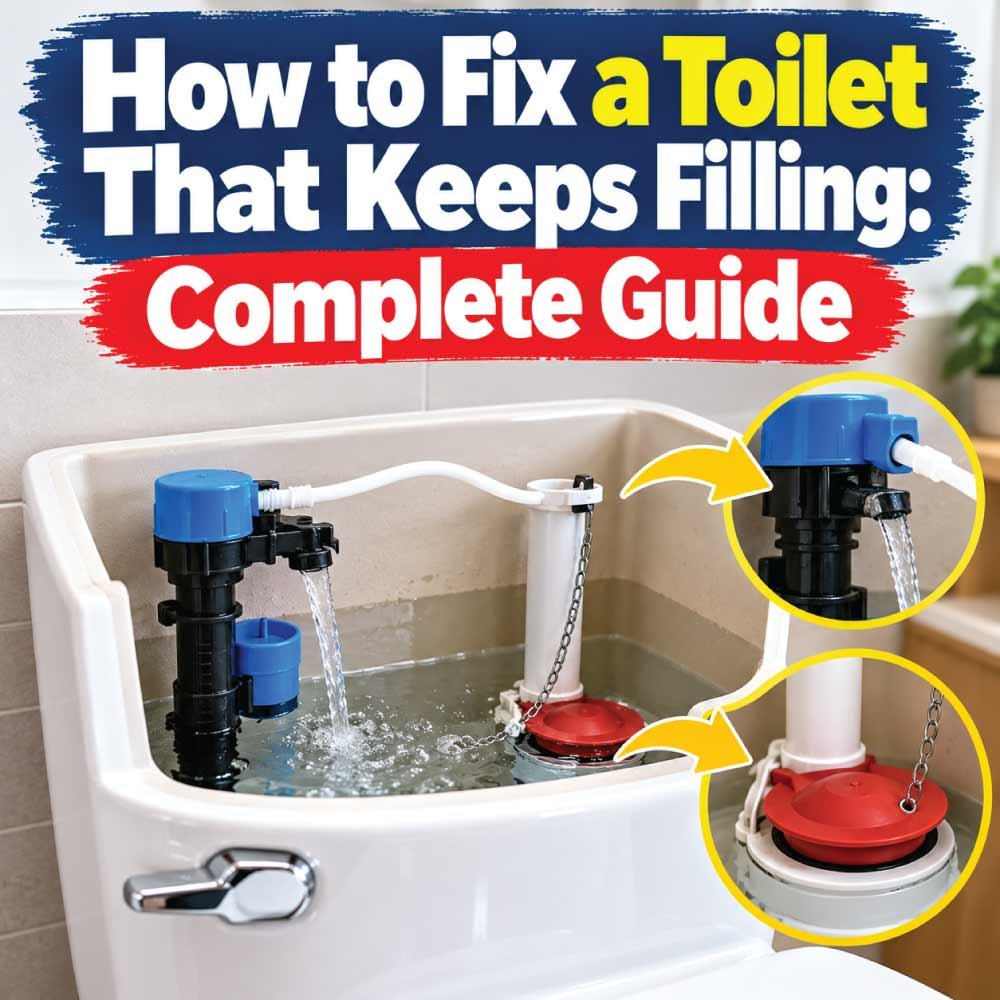
A toilet that keeps filling can be annoying, waste water, and increase your water bill. You may hear water running continuously into the tank, notice water trickling into the bowl, or hear the toilet refill repeatedly even when nobody has used it.
In most cases, the problem comes from a faulty fill valve, an incorrectly adjusted float, a leaking flapper, or a water level that is too high. The good news is that many of these issues can be diagnosed and repaired with basic tools.
This guide explains how to identify why your toilet keeps filling, troubleshoot the most common causes, replace worn components when necessary, and determine when to call a plumber.
How to Fix a Toilet That Keeps Filling: Quick Answer
If your toilet keeps filling after a flush, remove the tank lid carefully and observe what happens inside. If water continues entering the tank after it should have reached its normal level, the fill valve or float may be malfunctioning. If the tank fills and then starts refilling again without anyone flushing, water may be leaking past the flapper into the bowl.
Start with these checks:
Water keeps entering the tank: Inspect the fill valve and float.
Water flows into the overflow tube: Check the water level and fill valve adjustment.
The toilet refills every few minutes: Inspect the flapper and flush valve seal for leaks.
The tank fills slowly: Check whether the supply valve is open and whether the fill valve is obstructed or defective.
Water runs into the bowl continuously: Check the flapper, flush valve seal, and overflow level.
Before making repairs, turn off the toilet’s water supply if the tank is overflowing or the water cannot be controlled. The shutoff valve is usually behind or beside the toilet near the floor. Do not force a stuck or corroded valve.
Why Does a Toilet Keep Filling?
A toilet tank uses a fill valve to bring water into the tank and a float to help regulate the water level. When the tank reaches its intended fill level, the valve should stop the incoming water.
The flush valve and flapper hold water in the tank between flushes. If water escapes into the bowl, the tank may refill even when nobody has used the toilet.
Understanding these parts helps you distinguish between a filling problem and a leak that causes repeated refilling.
1. Faulty Toilet Fill Valve
The fill valve controls the flow of water into the toilet tank after flushing.
If the valve becomes worn, obstructed, or damaged, it may fail to shut off properly. Water can continue flowing into the tank even after the water level should have stabilized.
Common signs include:
- A continuous hissing or running sound.
- Water entering the tank without stopping.
- A tank that takes unusually long to fill.
- Water flowing into the overflow tube.
A fill valve adjustment may solve the problem if the water level is set incorrectly. If the valve is damaged or cannot shut off reliably, replacement may be necessary.
2. Incorrectly Adjusted or Stuck Float
The float rises as the tank fills and signals the fill valve to stop admitting water.
Depending on the toilet design, the float may be a cup-shaped component that slides along the fill valve or a separate floating ball connected to an arm.
If the float is set too high, stuck, or obstructed, the tank may overfill.
Look for a float that:
- Touches the tank wall or another component.
- Fails to move freely.
- Remains in a position that allows the valve to keep filling.
- Has an incorrect adjustment that places the water above the recommended fill level.
A simple adjustment or removal of an obstruction may correct the issue.
3. Worn or Leaking Toilet Flapper
A toilet flapper is a rubber or flexible seal at the bottom of many toilet tanks. It prevents tank water from flowing into the bowl when the toilet is not being flushed.
Over time, the flapper may deteriorate, warp, or develop mineral buildup that prevents a tight seal.
When water leaks from the tank into the bowl, the water level gradually drops. The fill valve then activates to replace the lost water, causing the toilet to refill repeatedly.
Typical signs include:
- The toilet refills every few minutes.
- Water trickles into the bowl between flushes.
- The tank fills, stops, and starts again without use.
- The flapper looks damaged or does not sit flat.
Replacing a worn flapper often resolves this type of problem, provided the replacement matches the toilet’s flush valve.
4. Water Level Set Too High
The tank water level must remain below the top of the overflow tube by the amount specified by the toilet or fill valve manufacturer.
If the water level is too high, excess water may flow into the overflow tube. The fill valve may continue admitting water, creating a continuous filling sound.
Check the tank’s fill mark or manufacturer instructions rather than relying on a universal measurement.
If the water level is too high, adjust the float according to the fill valve’s instructions. If the valve still does not shut off, it may be defective.
5. Damaged Flush Valve Seal
Some toilets use a canister-style flush valve or another sealing mechanism instead of a traditional flapper.
If the seal at the bottom of this assembly wears out, water may leak into the bowl. The tank then refills to replace the lost water.
Signs include repeated refilling even when the water level initially appears normal.
Inspect the flush valve seal if your toilet uses this design. Follow the manufacturer’s instructions to identify and replace the compatible seal.
6. Problems With the Overflow Tube
The overflow tube prevents the tank from overflowing if the water level rises too high. It directs excess water into the toilet bowl.
If the water level reaches the top of the overflow tube, water may flow continuously into the bowl.
The underlying problem is often a fill valve that does not shut off correctly or a float set too high. A damaged overflow tube can also require repair or replacement.
Do not assume the overflow tube itself is the cause simply because water is entering it. First determine why the water level is rising too far.
Tools and Materials You May Need
Most basic toilet-filling repairs require only a few items.
- Adjustable wrench, if required by the repair.
- Clean cloths or towels.
- Small bucket or container.
- Sponge for removing water from the tank.
- Rubber gloves.
- Flashlight.
- Replacement toilet flapper or flush valve seal, if needed.
- Compatible fill valve, if required.
- Manufacturer-recommended replacement parts.
You may not need all these items. Start by inspecting the toilet before purchasing anything.
Safety Precautions Before Repairing a Toilet
Before opening the tank or disconnecting any plumbing components, take a few precautions.
Turn off the water when necessary. Close the toilet’s shutoff valve if the tank is overflowing or you need to remove a component.
Do not force the shutoff valve. A stuck valve can break or begin leaking. If it will not operate normally, seek professional assistance.
Avoid unnecessary disassembly. Many adjustments can be made without removing the fill valve.
Handle the tank lid carefully. Porcelain lids can crack if dropped.
Wear gloves. Toilet tank water and components may contain germs or accumulated residue.
Keep water away from electrical equipment. If water reaches an outlet or energized equipment, do not touch the wet area or electrical components. Seek qualified assistance.
Use compatible replacement parts. Incorrect parts may not seal properly or may interfere with the flushing mechanism.
If water continues flowing and you cannot safely shut it off, contact a plumber rather than disconnecting a pressurized supply line.
Step-by-Step: How to Fix a Toilet That Keeps Filling
Follow these steps in order, starting with the simplest checks.
Step 1: Remove the Tank Lid and Observe the Water
Carefully lift the toilet tank lid and place it on a stable surface.
Observe the tank while the water is running. Do not put your hands near moving components until you understand how the mechanism operates.
Look for the following:
- Is water still entering the tank?
- Is the water level reaching the overflow tube?
- Is water trickling into the bowl?
- Does the fill valve stop and then restart?
- Does the float move freely?
What the results may indicate:
- Water continues entering the tank after it is full: the fill valve or float may be faulty.
- Water flows into the overflow tube: the water level may be too high or the fill valve may not shut off.
- The tank fills and then repeatedly refills: a leaking flapper or flush valve seal may be allowing water to escape.
Identifying the symptom first helps you avoid replacing the wrong component.
Step 2: Check and Adjust the Float
If the tank is overfilling, inspect the float.
- Identify whether your toilet uses a cup-style float or a ball float.
- Check whether the float is touching the tank wall or another component.
- Gently move the float through its normal range to see whether it moves freely.
- If the float is adjustable, follow the fill valve manufacturer’s instructions to lower the shutoff level.
- Allow the tank to fill and observe whether the valve stops at the correct level.
The adjustment method varies by fill valve. Some models use an adjustment screw, while others have a clip or different mechanism.
Do not bend plastic parts or force the float. If the float moves freely but the valve continues filling, the fill valve may need replacement.
Step 3: Inspect the Fill Valve
If adjusting the float does not stop the water, the fill valve may be defective.
First, check for visible obstructions and confirm that the float is not trapped or restricted. Some fill valves can be cleaned according to the manufacturer’s instructions.
If the valve continues to run, fails to shut off, or is visibly damaged, replacing it may be the most practical solution.
To replace a typical fill valve:
- Turn off the toilet’s water supply.
- Flush the toilet to lower the tank water level, provided the toilet bowl is draining normally.
- Use a sponge or small container to remove remaining water from the tank.
- Disconnect the water supply line according to the manufacturer’s instructions.
- Remove the retaining nut and old fill valve.
- Install a compatible replacement valve at the specified height and position.
- Reconnect the supply line and tighten the connection according to the instructions.
- Restore the water supply slowly.
- Allow the tank to fill and check for leaks around the connection.
- Adjust the water level according to the manufacturer’s instructions.
Do not overtighten plastic fittings. If the shutoff valve cannot stop the water completely, do not disconnect the supply line; have the water isolated safely first.
Step 4: Check the Toilet Flapper
If the toilet fills repeatedly even though the water level is not overflowing, check whether water is leaking from the tank into the bowl.
Look at the flapper at the bottom of the tank. It should sit properly over the flush valve opening when the toilet is not flushing.
Inspect for:
- Cracks or deterioration.
- Warping or curling edges.
- Mineral buildup on the sealing surface.
- A chain that prevents the flapper from closing completely.
- A flapper that appears misaligned.
If the chain is too tight, it may hold the flapper slightly open. Adjust it according to the toilet manufacturer’s instructions.
If the flapper is damaged or cannot form a proper seal, replace it with a compatible part.
Step 5: Replace a Worn Flapper
If inspection indicates that the flapper is worn, replacement is usually straightforward on a standard tank-style toilet.
- Turn off the water supply.
- Flush the toilet to lower the tank water level.
- Remove remaining water from the tank if necessary.
- Disconnect the chain from the flush lever.
- Release the old flapper from its mounting points.
- Install the compatible replacement flapper.
- Reconnect the chain and adjust it so the flapper can open fully and close completely.
- Restore the water supply and allow the tank to refill.
- Observe whether the flapper seals properly and the fill valve stops.
Some toilets use unusual flush valves or proprietary sealing systems. Check the toilet model before purchasing a replacement.
If the new flapper does not seal, inspect the flush valve seat for damage or deposits. A damaged valve seat may require additional repair.
Step 6: Check the Overflow Tube and Water Level
After making adjustments, watch the water level as the tank fills.
The water should stop at the manufacturer’s recommended level, below the top of the overflow tube as specified for the toilet.
If water continues entering the overflow tube, check the float adjustment again. If the water level is correctly adjusted but the fill valve does not shut off, the valve may be defective.
If the overflow tube is cracked or damaged, the toilet may require a compatible replacement flush valve assembly.
Do not continue operating a toilet that cannot control its water level reliably.
Step 7: Test the Toilet for Repeated Filling
Once the repair is complete, allow the tank to refill fully.
Check that:
- The fill valve shuts off normally.
- The water level remains stable.
- No water continues flowing into the overflow tube.
- The flapper or flush valve seal closes properly.
- The tank does not refill again without being flushed.
- No water leaks around the supply connection.
Flush the toilet once and watch the full refill cycle.
If the toilet stops filling normally and remains quiet afterward, the repair may have resolved the problem. Check again later to confirm that the tank is not losing water and refilling by itself.
If the toilet continues filling, turn off the water supply if safe and reassess the likely cause. Multiple components may be worn, or the toilet may require professional attention.
Also Read:
How to Tell Whether the Fill Valve or Flapper Is the Problem
The distinction is important because these parts perform different functions.
| Symptom | Likely Cause | Recommended Action |
|---|---|---|
| Water keeps entering the tank | Faulty fill valve or float adjustment | Inspect the float and fill valve |
| Water flows into the overflow tube | Water level too high or fill valve not shutting off | Adjust the float or replace the faulty valve |
| Toilet refills every few minutes | Leaking flapper or flush valve seal | Inspect the sealing component |
| Water trickles into the bowl continuously | Flapper or flush valve seal may be leaking | Check the seal and valve seat |
| Tank fills slowly | Supply restriction or faulty fill valve | Check the supply and inspect the valve |
| Water level rises too high despite adjustment | Fill valve may be defective | Follow model instructions or replace the valve |
These signs are useful diagnostic clues, but they do not guarantee a single cause. Inspect the mechanism before buying parts.
Common Mistakes to Avoid
Avoid these mistakes when repairing a toilet that keeps filling:
Replacing the fill valve without checking the float: A simple adjustment may solve the problem.
Replacing the flapper when the tank is overfilling: The fill valve or float may be the real issue.
Setting the water level too high: Water may continue flowing into the overflow tube.
Leaving the chain too tight: The flapper may not close completely.
Using incompatible replacement parts: A poorly fitting seal can cause continued leakage.
Forcing the shutoff valve: Old valves can break or leak when handled roughly.
Ignoring recurring refills: Repeated filling may indicate a leak that wastes water.
Using harsh chemicals inside the tank: Cleaning products can damage rubber seals and other components.
Also Read:
When to Call a Professional Plumber
Contact a plumber if the problem continues after you have checked the float, fill valve, and flapper.
Professional help is appropriate when:
The water supply valve is stuck, damaged, or leaking.
The toilet continues overflowing despite adjustments.
The flush valve assembly or overflow tube is damaged.
Water leaks from the tank or bowl.
Replacement parts do not fit the toilet.
The tank is cracked.
The toilet refills repeatedly and the source of water loss remains unclear.
You cannot safely disconnect the water supply.
If water is flowing uncontrollably, shut off the toilet’s water supply only if you can do so safely. If the valve will not close, seek prompt plumbing assistance.
Should You Repair or Replace a Toilet That Keeps Filling?
Most toilets that keep filling can be repaired without replacing the entire fixture.
Repair is usually worth considering when:
- The float needs adjustment.
- The fill valve is worn but replaceable.
- The flapper is damaged.
- The flush valve seal needs replacement.
- The tank and bowl are in good condition.
Replacement may be more practical when:
- The porcelain tank or bowl is cracked.
- Several components are damaged and compatible parts are difficult to obtain.
- The toilet has recurring problems that cannot be resolved reliably.
- The flush mechanism is damaged beyond a practical repair.
A constantly filling toilet does not automatically need a new tank or a new toilet. Identifying the source of the problem can prevent unnecessary replacement.
How to Prevent a Toilet From Filling Repeatedly
A few simple checks can help keep the toilet operating normally.
Inspect the tank components periodically. Look for a deteriorated flapper, restricted float, or signs of continuous water flow.
Replace worn seals promptly. Damaged flappers and flush valve seals can allow water to escape into the bowl.
Keep the water level properly adjusted. Follow the fill valve manufacturer’s instructions.
Avoid forcing the handle. Excessive force can damage the lever or chain.
Check for continuous running. Investigate hissing sounds or trickling water rather than ignoring them.
Use compatible parts. Confirm that replacement flappers, fill valves, and seals match your toilet.
Watch for slow refilling. A change in refill time may indicate a supply problem or a deteriorating valve.
Check after every repair. Make sure the tank fills, shuts off, and remains at a stable water level.
Regular inspection can help identify problems early and reduce unnecessary water waste.
Frequently Asked Questions
1. Why does my toilet keep filling even when nobody uses it?
A worn flapper or flush valve seal may allow water to leak from the tank into the bowl. As the water level drops, the fill valve activates to replace the lost water. Inspect the sealing component and replace it if it is damaged or incompatible.
2. Why does my toilet keep running after flushing?
The fill valve may not be shutting off correctly, the float may be set too high, or water may be flowing into the overflow tube. A leaking flapper can also cause the toilet to refill repeatedly. Observe the tank mechanism to determine which problem is most likely.
3. Can a faulty flapper cause a toilet to keep filling?
Yes. If the flapper does not seal the flush valve opening, water can escape into the bowl. The fill valve then replaces the lost water, sometimes causing the toilet to refill every few minutes.
4. How do I stop my toilet from filling continuously?
Check the float, water level, and fill valve first. If the tank is overfilling, the fill valve may need adjustment or replacement. If the tank fills and then repeatedly refills, inspect the flapper or flush valve seal for leaks. Turn off the water supply if the flow cannot be controlled safely.
5. Is a toilet that keeps filling wasting water?
It can be. Water flowing continuously into the overflow tube or leaking from the tank into the bowl can waste water even when the toilet is not being used. Address the cause promptly to prevent unnecessary water consumption.
6. Why does my toilet fill for a few seconds every few minutes?
This pattern often indicates that water is slowly leaking from the tank into the bowl through a worn flapper or flush valve seal. The fill valve activates whenever the tank water level drops enough to trigger it. Inspect the seal and replace it if necessary.
Conclusion
A toilet that keeps filling usually has a problem with the fill valve, float, flapper, water level, or flush valve seal. Start by observing what happens inside the tank, then make the simplest appropriate adjustment before replacing parts.
If the tank is overfilling, check the float and fill valve. If the toilet refills repeatedly without being flushed, inspect the flapper and flush valve seal. Always verify that the water stops normally after the repair, and contact a plumber if the problem persists or the supply cannot be shut off safely.

Engineer Ali Hasan is a garage door expert and the founder of FixFasty. With over 16 years of experience in mechanical systems and home maintenance, he provides practical, step-by-step guides on garage door installation, repairs, and maintenance, helping homeowners keep their garage doors safe, reliable, and long-lasting.