
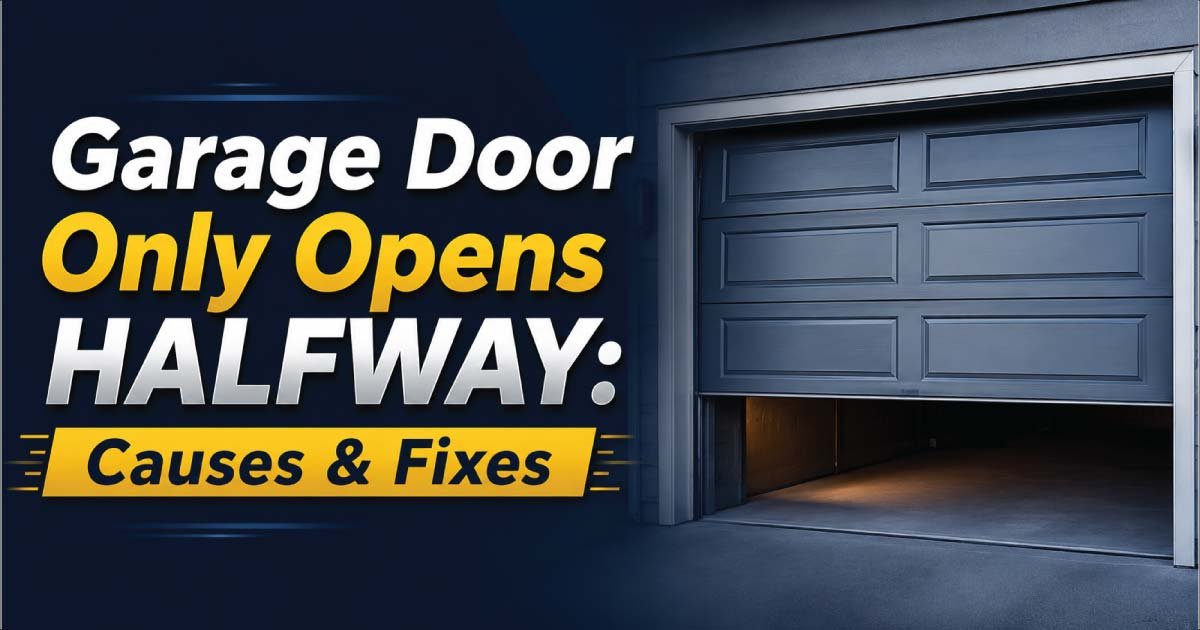
When your garage door only opens halfway, it can be frustrating, inconvenient, and sometimes a sign of a mechanical or electrical problem. A garage door that stops before reaching its fully open position may have an issue with the opener’s travel settings, tracks, springs, cables, sensors, or another component in the door system.
The good news is that some causes are relatively simple to identify and correct. For example, an incorrect opener travel limit or an obstruction in the tracks may be responsible. However, problems involving torsion springs, extension springs, cables, or other high-tension components can be dangerous and are usually best handled by a trained garage door technician.
This guide explains the most common reasons a garage door only opens halfway, what you can safely check yourself, and when professional garage door repair is the better option.
Why Does My Garage Door Only Open Halfway?
A garage door may stop halfway because the opener cannot complete its programmed travel, the door is experiencing excessive resistance, or a mechanical component is preventing normal movement.
Common causes include:
- Incorrect travel-limit settings
- An obstruction or damaged garage door track
- Dirty or poorly lubricated rollers and hinges
- A broken or weakened garage door spring
- Damaged or loose cables
- An opener that is struggling under load
- Photo-eye sensor problems
- An unbalanced garage door
- Cold, heat, or other environmental conditions
- A worn gear, motor, or internal opener component
Identifying exactly what happens when the door stops is important. Does the opener motor continue running? Does the door reverse? Does it stop silently? Does it open halfway manually but feel unusually heavy?
Those details can help narrow down the cause.
Common Causes of a Garage Door That Stops Halfway
1. Incorrect Opener Travel Limit Settings
One of the most common explanations is an incorrect garage door opener travel limit.
Most automatic openers have settings that tell the motor how far the door should travel in the open and closed directions. If the open travel limit has been changed, lost, or incorrectly programmed, the opener may believe that halfway is the correct stopping point.
This can happen after:
- A power outage or electrical issue
- Opener installation or adjustment
- Accidental changes to the programming
- Replacing opener components
- Servicing the garage door
- Normal wear or malfunction within the opener
If the door consistently stops at approximately the same position every time, the travel setting is worth investigating.
Check your opener’s owner’s manual before adjusting these settings. Different manufacturers use different adjustment procedures, and incorrect changes can cause the door to travel too far or fail to close properly.
2. Something Is Blocking the Tracks
Garage door tracks guide the rollers as the door moves. Dirt, debris, a tool, a small object, or a damaged section of track can create enough resistance to stop the door.
Inspect both vertical and horizontal tracks for:
- Bent sections
- Loose hardware
- Debris
- Rust or corrosion
- Misalignment
- Objects caught near the rollers
Do not attempt to force a severely bent track back into position while the door is under tension. A professional should inspect significant track damage.
3. Dirty, Dry, or Damaged Rollers
Garage door rollers need to move smoothly inside the tracks. If they are worn, damaged, or excessively dirty, they can increase friction and make the door difficult to lift.
You may notice:
- Squeaking or grinding sounds
- Jerky door movement
- The door slowing at a particular point
- Visible roller damage
- Increased vibration
Lubricating appropriate moving parts according to the door and opener manufacturer’s recommendations may help. Avoid applying excessive lubricant to the tracks themselves, because rollers need to roll along the track rather than slide through a layer of grease.
4. A Broken or Weak Garage Door Spring
The springs do much of the heavy lifting in a garage door system. If a spring breaks or loses significant tension, the opener may not be able to lift the door normally.
A broken spring can produce obvious symptoms, such as:
- The door feels extremely heavy when operated manually
- The door only opens partway
- The opener strains or stops
- A visible gap appears in a torsion spring
- The door suddenly becomes difficult to lift
- You hear a loud bang before the problem begins
A spring problem should be taken seriously. Garage door springs are under substantial tension, and attempting to remove, repair, or adjust them without the correct tools and training can cause severe injury.
5. Damaged or Loose Garage Door Cables
Lift cables work with the springs to raise and lower the door. If a cable comes off its drum, becomes frayed, or breaks, the door may become crooked or stop partway.
Look for:
- A visibly loose cable
- Fraying
- A cable that has come off its drum
- One side of the door sitting higher than the other
- A crooked or uneven door
Do not attempt to pull or reposition a cable while the spring system is under tension. Contact a professional garage door repair technician instead.
6. The Garage Door Is Out of Balance
An automatic opener is designed to move a properly balanced door. If the door becomes too heavy on one side or difficult to lift manually, the opener may struggle and stop before reaching the fully open position.
A properly balanced door should generally remain relatively stable when manually moved through its travel range. If the door drops rapidly, feels unusually heavy, or shoots upward, there may be a problem with the springs or another counterbalance component.
Because balance is closely connected to spring tension, professional inspection is recommended when the door feels significantly different from normal.
7. Garage Door Opener Problems
Sometimes the door itself is fine and the problem is inside the garage door opener.
Potential opener-related causes include:
- Worn gears
- A failing motor
- Overheating
- Damaged drive components
- Faulty limit switches
- Electrical problems
- An aging opener
If the opener works normally for part of the cycle but stops after repeated use, overheating may be a possibility. Some openers have built-in thermal protection and temporarily stop operating when the motor becomes too hot.
Allowing the opener to cool and checking whether the problem returns can provide useful information. Persistent problems should be diagnosed rather than repeatedly resetting the opener.
How to Diagnose a Garage Door That Only Opens Halfway
Before calling for garage door repair, you can perform a few basic observations and visual checks.
Step 1: Observe What the Opener Does
Use the wall control or remote and watch the door carefully.
Ask:
- Does the door stop at exactly the same height?
- Does it reverse direction?
- Does the opener light flash?
- Does the motor continue running?
- Does the door move slowly?
- Does it make unusual noises?
A consistent stopping point can suggest a travel-limit issue, while uneven or noisy movement may indicate a mechanical problem.
Step 2: Check for Visible Obstructions
Look along both sides of the door and inspect the tracks.
Remove only obvious, loose objects that are safely accessible. Do not put your hands near moving rollers, cables, springs, or other components while operating the door.
Step 3: Inspect the Door and Tracks
With the door stationary, look for visible damage.
| What You Notice | Possible Cause | Recommended Action |
|---|---|---|
| Door always stops at the same height | Travel-limit issue | Check opener manual/settings |
| Door is crooked | Cable, spring, or track problem | Call a technician |
| Door feels very heavy | Spring/counterbalance issue | Professional inspection |
| Grinding or squealing | Rollers/hinges or hardware | Inspect and service |
| Opener strains | Excessive resistance or opener issue | Stop repeated operation |
| Door reverses unexpectedly | Sensor, obstruction, or force issue | Inspect safely |
| Spring has a visible gap | Broken spring | Professional repair |
Step 4: Consider Manual Operation Carefully
If your garage door has a manual release, disconnecting the opener can help determine whether the issue is with the door or opener. However, only do this if the door is in a safe, stable position and you can follow the manufacturer’s instructions.
A garage door that is extremely heavy, falls, binds, or feels unstable should not be operated manually.
Garage Door Only Opens Halfway but Works Manually
If the garage door moves smoothly through its full range when disconnected from the opener, the automatic opener may be the source of the problem.
Possible causes include:
- Incorrect travel limits
- Incorrect force settings
- Faulty limit controls
- A weak or failing motor
- Internal gear damage
- An opener compatibility issue
If the door itself moves normally but the opener stops it halfway, troubleshooting should focus on the opener rather than immediately replacing door components.
Conversely, if the door also stops halfway when operated manually, there is likely a mechanical issue with the door, tracks, rollers, springs, or cables.
Garage Door Opens Partway and Then Reverses
A door that opens partway and reverses can have a somewhat different cause from one that simply stops.
Possible Causes
- Excessive resistance
- Incorrect force settings
- A damaged track
- Obstructed or damaged rollers
- An opener control problem
- Mechanical binding
If the opener senses that the door is encountering unusual resistance, its safety mechanisms may cause it to stop or reverse.
Do not increase the opener’s force setting simply to make a difficult door move. If the door has a mechanical problem, increasing the force can create additional stress and potentially defeat the purpose of the opener’s safety features.
What You Can Safely Fix Yourself
Some basic maintenance tasks are appropriate for homeowners, provided they can be completed without working around high-tension components.
Safe DIY Checks
You can generally:
- Remove obvious debris from around the door
- Check whether anything is blocking the tracks
- Inspect visible hardware for obvious looseness
- Clean photo-eye sensor lenses with a soft, dry cloth
- Check that the sensor lenses face one another
- Review the opener manual
- Inspect the door for visible damage
- Lubricate manufacturer-approved moving components as directed
Always disconnect power when the manufacturer’s instructions call for it, and keep hands and clothing away from moving parts.
Tasks Best Left to a Professional
Avoid DIY repairs involving:
- Torsion spring adjustment
- Extension spring replacement
- Cable replacement
- Cable drum repair
- Major track realignment
- Spring removal
- Significant structural damage
- Opener electrical repairs
The potential injury risk is much greater than the cost savings from attempting these repairs yourself.
When Should You Call a Garage Door Repair Professional?
Professional service is recommended if the door is heavy, crooked, damaged, or unsafe to operate.
Contact a technician promptly if:
- A spring is broken
- A cable has snapped or come off
- The door is hanging unevenly
- The tracks are significantly bent
- The door falls or drops unexpectedly
- The opener makes grinding or burning noises
- The door repeatedly gets stuck
- You smell burning from the opener
- The door cannot be safely moved
- Basic troubleshooting does not resolve the issue
A qualified technician can inspect the complete system instead of replacing individual parts based only on symptoms.
How to Prevent a Garage Door From Stopping Halfway
Regular maintenance can reduce the likelihood of unexpected garage door problems.
Perform Visual Inspections
Every few months, inspect:
- Tracks
- Rollers
- Hinges
- Cables
- Springs
- Brackets
- Door panels
- Opener components
Look for unusual wear, rust, fraying, cracks, or loose hardware.
Keep the Door and Opener Clean
Dust and debris can accumulate around mechanical components. Keeping the garage door area clean helps you spot developing problems before they become serious.
Use the Correct Lubricant
Follow the manufacturer’s recommendations for lubricating rollers, hinges, bearings, and other applicable components. Avoid treating every part of the system with the same lubricant.
Don’t Ignore Strange Noises
A garage door rarely develops a major problem without showing some warning signs. New grinding, popping, scraping, or excessive vibration deserves attention.
Schedule Professional Maintenance
A professional inspection can identify worn springs, cables, rollers, bearings, and opener components before they fail completely.
Garage Door Halfway Open: Repair or Replace?
Whether you need a repair or a replacement depends on the component causing the problem and the overall condition of the system.
| Situation | Likely Solution |
|---|---|
| Incorrect opener settings | Adjustment/reprogramming |
| Worn roller | Roller replacement |
| Damaged hinge | Hinge replacement |
| Broken spring | Spring replacement |
| Damaged cable | Cable replacement |
| Bent track | Track repair/replacement |
| Failing opener | Opener repair or replacement |
| Multiple severely worn components | Professional evaluation |
| Severely damaged or deteriorated door | Door replacement may be appropriate |
A halfway-opening door does not automatically mean you need a new garage door. In many cases, repairing one faulty component can restore normal operation.
Frequently Asked Questions
Why does my garage door stop halfway when opening?
The most common possibilities include incorrect opener travel settings, excessive resistance, damaged tracks or rollers, an unbalanced door, worn springs, cable problems, or an opener malfunction. The exact cause depends on whether the door also has trouble when operated manually.
Why does my garage door only open a few feet?
If it opens only a short distance and consistently stops, the opener may have a travel-limit or force-setting problem. Mechanical resistance from the tracks, rollers, springs, or cables can also cause limited movement.
Can a broken spring cause a garage door to only open halfway?
Yes. A broken or weakened spring can prevent the opener from lifting the door properly. The door may become extremely heavy, uneven, or difficult to operate. Spring repairs should be handled by a trained professional.
Should I adjust the garage door opener force?
Not as a first response. Increasing force to overcome resistance can mask an underlying mechanical problem and may create a safety concern. First determine why the door is encountering resistance.
Can I lubricate my garage door tracks?
Generally, the tracks themselves should not be heavily lubricated. The rollers need to roll along the track, and excessive lubricant can attract dirt. Follow the manufacturer’s maintenance instructions for the specific door system.
How much does it cost to fix a garage door that only opens halfway?
The cost varies significantly depending on the cause, location, door type, parts required, and labor. A simple adjustment may cost considerably less than replacing a broken spring, damaged cable, track, or opener. Getting a diagnosis before approving replacement work is the best way to avoid unnecessary expense.
Final Thoughts:
When a garage door only opens halfway, don’t assume that the entire door or opener needs to be replaced. Start by observing exactly how the door behaves, checking for obvious obstructions, and looking for visible signs of damage.
Simple issues such as travel-limit settings, dirty sensors, or an obstruction may be relatively straightforward to address. However, springs, cables, significant track damage, and serious opener problems require greater caution.
If the door is unusually heavy, crooked, unstable, or making loud mechanical noises, stop operating it and arrange a professional inspection. Addressing the underlying problem early can prevent additional damage, improve garage door safety, and help restore reliable operation.

Engineer Ali Hasan is a garage door expert and the founder of FixFasty. With over 16 years of experience in mechanical systems and home maintenance, he provides practical, step-by-step guides on garage door installation, repairs, and maintenance, helping homeowners keep their garage doors safe, reliable, and long-lasting.