
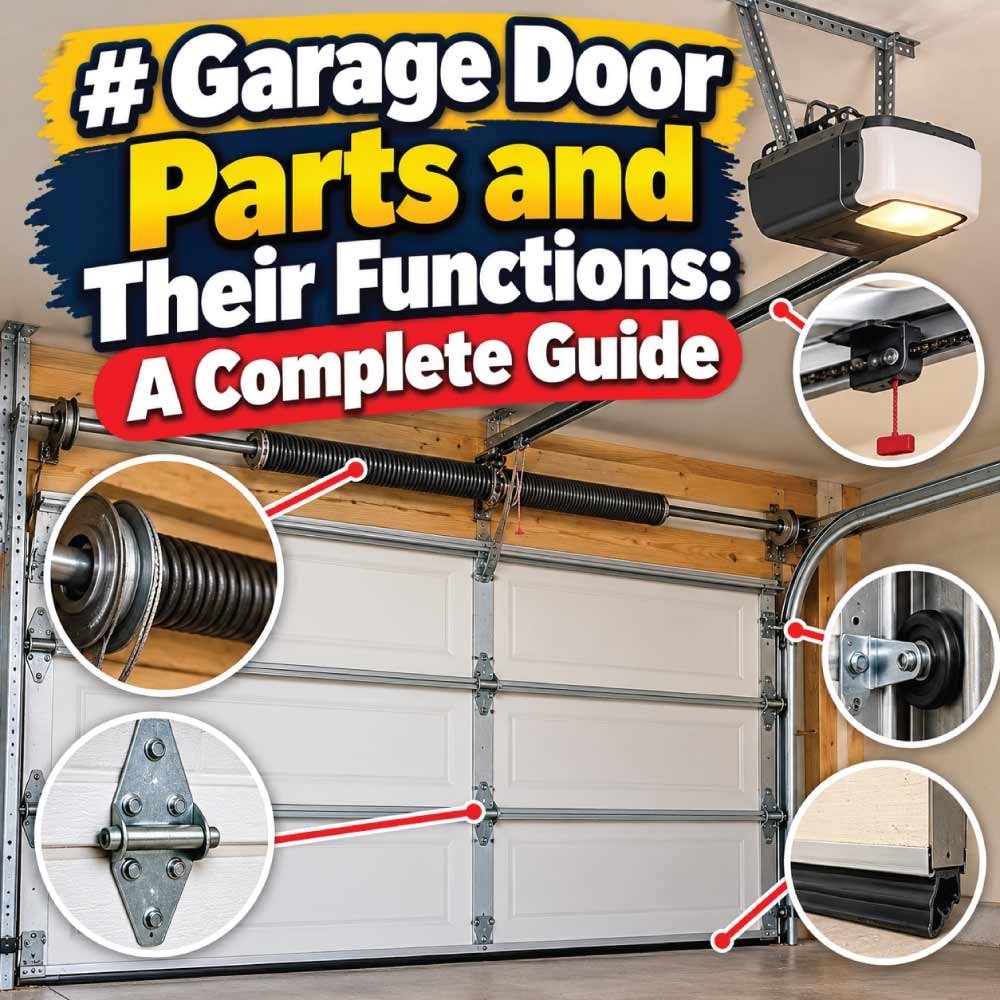
Garage doors rely on several connected components to open, close, and remain secure. Whether you have a sectional garage door, a roll-up model, or a traditional one-piece door, understanding the main garage door parts helps you recognize problems, choose replacement components, and maintain the system properly.
Some parts, such as hinges, rollers, and tracks, guide the door’s movement. Others, including springs, cables, and the opener, provide or control the force needed to operate it. Each component has a specific role, and a problem with one part can affect the entire door.
This guide explains the most important garage door parts and their functions, how the components work together, common signs of wear, and what to consider when selecting replacements. It also highlights safety precautions because certain garage door components operate under dangerous tension.
What Are the Main Parts of a Garage Door?
A garage door is a complete mechanical system rather than a single panel. Its construction depends on the door style, weight, material, and operating mechanism, but most residential sectional garage doors share several essential components.
The following table provides a quick overview of common garage door parts and their primary functions.
| Garage Door Part | Main Function | Typical Location |
|---|---|---|
| Door panels | Form the main door surface | Across the door opening |
| Tracks | Guide the door as it moves | Along the sides and ceiling |
| Rollers | Allow the door to travel through the tracks | Along the door edges |
| Hinges | Connect sectional door panels | Between panels |
| Torsion or extension springs | Counterbalance the door’s weight | Above the door or along the sides |
| Lift cables | Transfer lifting force to the door | Near the lower corners or cable drums |
| Cable drums | Wind and unwind lift cables | On the torsion shaft |
| Garage door opener | Powers automatic opening and closing | Usually on the ceiling |
| Drive mechanism | Transfers opener power to the door | Along the opener rail or shaft |
| Photo-eye sensors | Detect obstructions in the closing path | Near the bottom of the opening |
| Bottom seal | Helps block water, dirt, and drafts | Along the bottom edge |
| Weatherstripping | Reduces gaps around the door | Along the sides and top |
| Locks and handles | Provide manual access or security | On the door or its frame |
Not every garage door uses every component listed. For example, a one-piece tilt-up door has a different hinge and support arrangement from a sectional door. Always identify your door type before ordering replacement parts.
Garage Door Panels and Sections
What Are Garage Door Panels?
Garage door panels form the main surface that covers the garage opening. On a sectional garage door, several horizontal sections are connected by hinges, allowing the door to bend as it travels from the vertical tracks into the horizontal ceiling tracks.
Panels are available in different materials and constructions, including steel, aluminum, wood, fiberglass, and composite materials. Some models include insulation between layers to improve thermal performance and reduce outside noise.
The material affects the door’s weight, maintenance requirements, appearance, and compatibility with springs and openers.
Common Types of Garage Door Panels
- Steel panels: Common in residential garages because they offer a range of styles, finishes, and insulation options.
- Aluminum panels: Often lighter than steel, although resistance to dents depends on the panel design and thickness.
- Wood panels: Provide a traditional appearance but generally require more maintenance to protect against moisture and deterioration.
- Fiberglass or composite panels: Offer alternative finishes and performance characteristics depending on their construction.
When Do Panels Need Replacement?
Minor cosmetic damage may not affect operation, but significant bending, cracking, rust, or separation between panel layers can weaken the door.
A damaged panel can also interfere with the rollers and tracks. Because panels contribute to the door’s overall weight and structural integrity, replacement should account for the manufacturer’s design and the condition of adjoining sections.
Garage Door Tracks and Rollers
Garage Door Tracks
Garage door tracks are metal channels that guide the rollers and keep the door moving along its intended path. On a typical sectional door, the track system includes vertical tracks on both sides of the opening and horizontal tracks that extend toward the ceiling.
The curved sections connect these tracks and allow the door to transition from a vertical position to a horizontal one.
Tracks must be properly aligned and securely attached to suitable supports. Bent tracks, loose brackets, or incorrect spacing can cause binding, unusual noises, or uneven movement.
Garage Door Rollers
Rollers are small wheels that travel inside the tracks. Their job is to reduce friction and help the door move smoothly.
Rollers may have steel, nylon, or other manufacturer-specified wheel designs. Their stems and bearings must be compatible with the hinges, track dimensions, and door system.
Common signs of roller problems include:
- Grinding, squeaking, or rattling during operation.
- Visible wear, cracks, or flat spots on roller wheels.
- A door that moves unevenly or hesitates along the track.
- Excessive vibration when the door opens or closes.
Tracks vs. Rollers: What’s the Difference?
Tracks provide the route, while rollers move along that route. Both are necessary for smooth operation, but they serve different purposes.
Cleaning accessible track surfaces and inspecting the rollers can help identify wear. Avoid bending tracks back into position without understanding the cause of the problem. Track alignment affects the door’s movement and can create additional hazards if adjusted incorrectly.
Garage Door Hinges and Brackets
Garage Door Hinges
Hinges connect the horizontal sections of a sectional garage door. They allow the panels to pivot relative to one another as the door bends around the curved tracks.
Hinges are commonly made from metal, with their design and thickness varying according to the door’s construction and intended use.
Some hinges primarily connect panels, while others also support roller stems. The hinge number or position may indicate a particular function, so replacement parts should match the original manufacturer’s specifications.
Garage Door Brackets
Brackets attach important components to the door or its supporting structure. Their functions vary according to location.
- Bottom brackets: Often connect the lift cables to the door and support cable-related hardware.
- Top brackets: Support or position rollers at the upper edge of the door.
- Track brackets: Secure tracks to the wall or ceiling supports.
- Opener brackets: Connect the opener arm to the door where the design requires one.
Important safety warning: Bottom brackets on many sectional garage doors are connected to the lift cables and spring-counterbalance system. They can be under substantial tension. Do not remove, loosen, or adjust these brackets unless the manufacturer explicitly provides a safe procedure for the specific system and you are qualified to perform the work.
Garage Door Springs and Counterbalance Systems
Garage door springs are among the most important parts of the entire system. A residential garage door can be heavy, and its counterbalance system reduces the force required to lift it.
The springs do not simply make the door move by themselves. They store and release energy to offset much of the door’s weight, allowing a person or an electric opener to raise and lower it more easily.
Torsion Springs
Torsion springs are commonly installed on a shaft above the garage door opening. As the door moves, the spring system stores or releases rotational energy to help counterbalance the door.
The shaft, cable drums, bearings, and lift cables work together with the springs. The exact configuration varies by door design.
A torsion spring may show signs of failure such as a visible gap in the coil, a door that suddenly becomes difficult to lift, or an opener that struggles to move the door. However, a door that will not operate can also have other mechanical or electrical causes.
Extension Springs
Extension springs are generally installed along the sides of the horizontal tracks on systems designed for this arrangement. They stretch as the door moves and release stored energy to assist lifting.
Many extension-spring systems use safety cables intended to help contain a broken spring. These cables and their attachment points must be installed and maintained according to the manufacturer’s instructions.
Torsion Springs vs. Extension Springs
| Feature | Torsion Springs | Extension Springs |
|---|---|---|
| Typical location | Above the door opening | Along the horizontal tracks |
| Operating principle | Twisting force | Stretching force |
| Main supporting components | Shaft, drums, cables, and bearings | Pulleys, cables, and safety cables where specified |
| Space requirements | Requires suitable overhead space | Requires suitable side-track space |
| Replacement considerations | Correct spring specifications and winding arrangement | Correct spring rating, length, and safety arrangement |
Neither system is universally better for every garage. Compatibility, door weight, available space, and the manufacturer’s design determine the appropriate configuration.
Why Garage Door Springs Are Dangerous
Springs can store enough energy to cause serious injury if they break or are released incorrectly. A door may also fall unexpectedly if its counterbalance system fails.
Do not attempt to wind torsion springs, stretch extension springs, or remove tension-loaded components as a routine DIY repair. Spring selection and adjustment should be handled by a qualified garage door technician using the correct equipment and procedures.
Garage Door Lift Cables and Cable Drums
Lift Cables
Lift cables help transfer the counterbalancing force to the door. Depending on the design, the cables connect near the lower corners of the door and run toward drums or pulleys associated with the spring system.
When the door opens, the cables move with the mechanism and help lift the door evenly. If a cable becomes damaged or loses its proper position, the door may tilt, bind, or become unstable.
Watch for these warning signs:
- Frayed, kinked, or visibly damaged cable strands.
- A cable that appears loose or has come off its drum.
- One side of the door sitting lower than the other.
- A sudden change in the door’s balance or movement.
Stop operating the door if a cable appears damaged or displaced. Do not pull the cable, attempt to rewind it, or loosen the bottom brackets. Have the system inspected by a qualified technician.
Cable Drums
Cable drums are grooved components typically mounted near the ends of a torsion shaft. They guide and wind the lift cables as the door moves.
The grooves help maintain the intended cable path. Drum design, diameter, and compatibility matter because they affect the relationship between shaft rotation and door travel.
A damaged drum, incorrectly seated cable, or mismatched replacement component can disrupt lifting and place uneven loads on the system. Cable drums should therefore be matched to the door’s counterbalance arrangement rather than selected by appearance alone.
Garage Door Opener and Drive Mechanism
What Does a Garage Door Opener Do?
A garage door opener is the powered device that opens and closes an automatic garage door. It usually includes an electric motor, control electronics, a drive mechanism, and safety-related features.
The opener moves the door, but it is not designed to compensate for a broken spring or a poorly balanced door. If the door is too heavy to lift manually, continuing to operate the opener can damage equipment and create safety risks.
Common Types of Garage Door Openers
The best option depends on the garage layout, door weight, noise requirements, and compatibility.
| Opener Type | How It Works | Main Consideration |
|---|---|---|
| Chain drive | Uses a chain to move the door trolley | Durable design, but can be relatively noisy |
| Belt drive | Uses a reinforced belt to move the trolley | Often quieter than a comparable chain drive |
| Screw drive | Uses a rotating threaded rod or screw mechanism | Maintenance and noise depend on the design |
| Direct drive | Uses a motor arrangement that moves the door along a rail | Construction and service requirements vary |
| Jackshaft | Uses a motor to operate a compatible torsion shaft | Requires a suitable door and counterbalance setup |
These categories describe common drive arrangements, not universal performance guarantees. Actual noise levels, lifting capacity, speed, and maintenance needs depend on the model and installation.
The Opener Rail, Trolley, and Door Arm
On many ceiling-mounted openers, the rail extends from the motor toward the door. A trolley travels along this rail, while an arm connects the trolley to the door.
When the motor operates, the drive mechanism moves the trolley. The connected arm then pushes or pulls the door through its travel path.
If the opener runs but the door does not move, the issue might involve the trolley connection, drive mechanism, manual-release system, or door hardware. Stop using the opener if the door is jammed, unusually heavy, or visibly out of alignment.
Remote Controls, Wall Buttons, and Smart Features
Garage door controls send commands to the opener. Depending on the system, these may include:
- Handheld remote controls.
- A wall-mounted push button or control panel.
- Wireless keypads.
- Smartphone-connected controls.
- Vehicle-integrated transmitters.
A remote that fails to operate the door may have a depleted battery, a programming issue, interference, or an opener-related fault. Consult the manufacturer’s troubleshooting instructions before replacing parts.
Garage Door Safety Sensors and Limit Controls
Photo-Eye Safety Sensors
Photo-eye sensors are typically installed near the bottom of the garage door opening, one on each side. They establish an invisible beam across the opening. If the beam is interrupted while the door is closing, the opener’s safety system is designed to prevent or reverse closing movement, according to its configuration.
Dirty lenses, misaligned sensors, loose wiring, or an obstructed beam can prevent normal operation.
To check the accessible sensor area:
- Remove objects blocking the space between the sensors.
- Gently clean the sensor lenses using the manufacturer’s recommended method.
- Check whether the indicator lights show normal alignment, if your model uses them.
- Consult the opener manual if the door still refuses to close.
Never bypass a safety sensor to make the door close. If the sensors do not operate correctly, arrange a repair.
Travel Limits and Force Settings
Travel limits determine how far the opener moves the door in the opening and closing directions. Force settings control how the opener responds to resistance during movement.
These settings are different from the mechanical spring balance. Incorrect adjustments can cause incomplete closure, excessive pressure against the floor, or unsafe responses to an obstruction.
Follow the opener’s specific instructions for testing and adjustment. If the door reverses unexpectedly, closes too forcefully, or fails a safety test, discontinue automatic operation until the fault has been resolved.
Also Read:
Garage Door Weatherstripping, Bottom Seals, and Insulation
Bottom Seal
The bottom seal is a flexible strip attached along the lower edge of the door. It helps close the gap between the door and the garage floor.
Depending on its design, it may be made from rubber, vinyl, or another flexible material. The seal can help limit drafts, water entry, dust, leaves, and small debris.
If the bottom seal becomes brittle, torn, flattened, or detached, it may no longer contact the floor evenly. Replacement requires the correct seal profile and a compatible retaining channel.
A bottom seal cannot compensate for a badly uneven floor or a door that is out of alignment.
Side and Top Weatherstripping
Weatherstripping along the sides and top of the opening reduces gaps between the closed door and its frame. It may use flexible rubber, vinyl, or brush-style material, depending on the system.
Inspect these seals for:
- Cracks and brittle sections.
- Missing or loose fasteners.
- Gaps at the corners.
- Areas that no longer contact the door.
Weatherstripping should make appropriate contact without preventing the door from moving freely.
Garage Door Insulation
Insulation is a feature of the door panel assembly rather than a universal separate mechanical component. Insulated doors may use foam cores or other insulating materials between layers.
The complete door’s thermal performance depends on more than insulation alone. Panel construction, joints, seals, glazing, and installation all influence heat transfer and air leakage.
When replacing panels or adding insulation, confirm compatibility with the door manufacturer. Additional weight can affect the counterbalance system and opener requirements.
Garage Door Locks, Handles, and Manual Release Components
Garage Door Locks and Handles
Locks and handles provide manual access and help secure certain garage door designs. Some sectional doors use an integrated lock, while others rely on the automatic opener’s locking features or a separate security system.
Manual locks must be disengaged before operating an opener if the manufacturer requires it. Attempting to open a mechanically locked door can damage the opener, door panels, or connecting hardware.
Handles are more common on manually operated doors, although their design varies. Replace damaged handles with compatible hardware that does not interfere with the door’s movement.
Emergency Release Cord
Many automatic garage door openers have a manual emergency-release mechanism, often operated by a cord hanging from the trolley.
It allows the door to be disconnected from the opener so that the door can be operated manually when appropriate. This is particularly useful during a power outage, provided the door itself is functioning safely.
Never pull the release cord when the door is open and appears unbalanced or has a broken spring or cable. The door may fall suddenly. Follow the opener manufacturer’s instructions for disengaging and reconnecting the trolley.
Also Read:
Common Garage Door Problems and the Parts Involved
Understanding the relationship between symptoms and components can help you describe a problem accurately to a technician. However, the same symptom can have several possible causes.
| Problem | Possible Components Involved | Recommended Action |
|---|---|---|
| Door makes squeaking noises | Rollers, hinges, or bearings | Inspect accessible parts and follow lubrication instructions |
| Door moves unevenly | Tracks, rollers, cables, or springs | Stop operation if the door is tilted or unstable |
| Opener runs but door does not move | Trolley, drive mechanism, or release system | Check the manual and avoid forcing the door |
| Door will not close fully | Sensors, travel limits, tracks, or obstructions | Check the sensor area and consult the opener manual |
| Door feels unusually heavy | Springs or counterbalance components | Stop using the door and contact a technician |
| Remote control does not work | Remote battery, programming, or opener receiver | Follow the manufacturer’s troubleshooting procedure |
| Light enters beneath the closed door | Bottom seal, floor level, or door alignment | Inspect the seal and assess the floor gap |
| Door reverses unexpectedly | Sensors, force settings, or mechanical resistance | Stop repeated operation and investigate the cause |
This table is a starting point, not a definitive diagnostic guide. Do not remove spring-loaded components or continue operating a door that appears unsafe.
How to Choose the Correct Garage Door Replacement Parts
Selecting the correct garage door parts involves more than matching their appearance. A component that looks similar may have different dimensions, load ratings, attachment points, or operating characteristics.
1. Identify the Door Type and Model
Determine whether the door is sectional, one-piece tilt-up, roll-up, or another design. If possible, locate the manufacturer’s label on the door or opener.
Record the brand, model number, and any available part number before searching for replacements.
2. Confirm Measurements and Compatibility
Depending on the component, relevant details may include:
- Rollers: Wheel diameter, stem dimensions, bearing design, and track compatibility.
- Hinges: Hole spacing, hinge position, and manufacturer-specific design.
- Weatherstripping: Seal profile, retaining-channel shape, and required length.
- Opener components: Model number, drive type, and compatibility with the existing system.
- Springs and cables: Manufacturer-specified dimensions, ratings, configuration, and door requirements.
Spring selection is especially sensitive to the door’s weight and geometry. Do not choose springs solely by measuring an old spring or copying its visible dimensions.
3. Consider Material and Environmental Conditions
Steel, nylon, rubber, and other materials have different characteristics. Outdoor exposure, moisture, temperature changes, and usage frequency can influence the life of certain components.
Choose replacement parts designed for the actual application rather than assuming that a more expensive or heavier component will always be better.
4. Follow Manufacturer Documentation
Check the manufacturer’s parts diagrams, installation instructions, and compatibility guidance. If the original component is discontinued, ask the manufacturer or a qualified supplier for an approved replacement.
Avoid modifying tracks, brackets, spring systems, or opener connections to accommodate a part that is not designed for the door.
Garage Door Parts Maintenance and Safety Tips
Routine visual inspections can help identify problems before they cause more extensive damage. The goal is to recognize wear and keep accessible components clean, not to dismantle the door’s counterbalance system.
Useful maintenance practices include:
- Inspect the door visually: Look for damaged panels, loose-looking hardware, worn seals, and visible cable damage.
- Keep tracks clear: Remove loose debris from accessible track surfaces without bending or dismantling the tracks.
- Listen during operation: New grinding, scraping, or unusual banging sounds deserve attention.
- Check the weather seals: Replace deteriorated seals with compatible parts.
- Follow lubrication instructions: Lubricate only the components specified by the manufacturer, using the recommended product.
- Test safety features: Follow the opener manufacturer’s procedures for testing photo-eye sensors and automatic reversal.
- Arrange professional servicing: Have springs, cables, and other high-tension components inspected or repaired when necessary.
Never place your hands between moving door sections, stand beneath an unsupported door, or attempt to catch a falling door. Disconnecting the opener’s power does not remove the stored energy in the spring system.
If a spring breaks, a cable comes off its drum, or the door becomes crooked, keep people away from the area and arrange professional repair.
Frequently Asked Questions About Garage Door Parts
What are the most important parts of a garage door?
The main components of a typical sectional garage door include panels, tracks, rollers, hinges, springs, lift cables, brackets, and an opener if the door is automatic. Safety sensors and weather seals provide additional operating protection and environmental benefits.
What parts make a garage door open and close?
The counterbalance springs help offset the door’s weight, while lift cables and associated hardware transfer force to the door. On an automatic system, the opener and drive mechanism move the door through its tracks.
Are garage door springs and cables interchangeable?
No. Springs store energy to counterbalance the door, while lift cables transmit force through the lifting mechanism. Both must match the specific door system, but they perform different functions.
Can I replace garage door rollers myself?
Some roller-related maintenance may be suitable for experienced DIY users, but replacement safety depends on the roller’s location and the door design. Rollers near bottom brackets or other tension-loaded components can be particularly hazardous. Follow the manufacturer’s instructions and hire a qualified technician when safe access is uncertain.
How do I know which garage door part needs replacement?
Look for visible damage, unusual sounds, inconsistent movement, or problems with the opener’s controls and sensors. These clues can help narrow down the possibilities, but they do not always identify the failed part. A professional inspection may be necessary.
Do all garage doors use the same parts?
No. Component arrangements vary by door style, manufacturer, size, weight, and operating mechanism. A part designed for one sectional door may not fit another door, even if both appear similar.
Conclusion
Understanding garage door parts and their functions makes it easier to recognize wear, investigate operating problems, and choose compatible replacements. Panels form the door, tracks and rollers guide its movement, hinges connect sections, and springs and cables support the lifting system. The opener, controls, sensors, locks, and weather seals provide additional functions.
The most important rule is to match every replacement part to the specific door and follow the manufacturer’s instructions. Routine visual inspections can help you spot problems early, while spring, cable, and other high-tension repairs should be left to qualified professionals.

Engineer Ali Hasan is a garage door expert and the founder of FixFasty. With over 16 years of experience in mechanical systems and home maintenance, he provides practical, step-by-step guides on garage door installation, repairs, and maintenance, helping homeowners keep their garage doors safe, reliable, and long-lasting.