
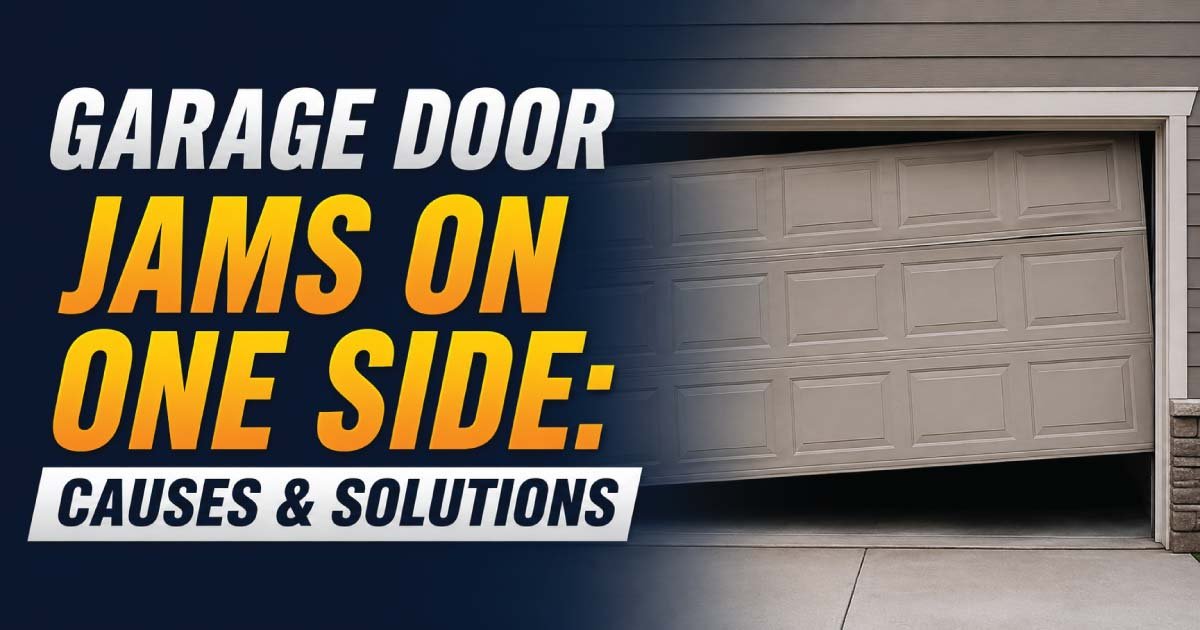
A garage door that jams on one side is more than a minor inconvenience. If one side of the door sticks, rises unevenly, scrapes against the track, or appears crooked, the problem may involve the tracks, rollers, cables, springs, or the door itself. Continuing to operate a misaligned garage door can turn a relatively simple repair into a costly and potentially dangerous one.
The good news is that many causes of a garage door jamming on one side can be identified through a careful visual inspection. Some minor issues, such as debris in the track or a loose hinge, may be straightforward to address. However, problems involving torsion springs, extension springs, lift cables, or significant structural damage should be handled by a qualified garage door professional.
This guide explains the most common reasons a garage door jams on one side, what symptoms to look for, which solutions may be appropriate, and when it is safer to call for professional garage door repair.
What Does It Mean When a Garage Door Jams on One Side?
A garage door should move smoothly and evenly along both tracks. When one side jams, the door may tilt, bind, stop partway, make unusual noises, or move more slowly on one side than the other.
Common signs include:
- One side of the door rises before the other.
- The door becomes crooked when opening or closing.
- One roller comes out of the track.
- The door scrapes against a track.
- The opener strains or reverses unexpectedly.
- The door stops several inches above the floor.
- A lift cable appears loose or has come off its drum.
- The door makes grinding, popping, or rubbing sounds.
A one-sided jam usually indicates that the two sides of the garage door system are no longer moving in balance. Because the door’s weight is distributed across multiple components, a failure on one side can affect the entire system.
Common Causes of a Garage Door Jamming on One Side
Several components can cause uneven garage door movement. Identifying the likely source is the first step toward an effective solution.
1. Bent or Misaligned Garage Door Track
The tracks guide the rollers as the door moves. If one track becomes bent, loose, or misaligned, the rollers may have difficulty traveling through it.
Track problems can develop after:
- A vehicle accidentally hits the track.
- Heavy objects strike the track.
- Mounting hardware becomes loose.
- The garage structure shifts.
- The track is damaged by repeated stress.
A bent vertical track may cause the door to scrape or jam on one side. Even a small amount of misalignment can prevent the rollers from moving smoothly.
Potential solution: Inspect the track for obvious bends, gaps, loose fasteners, or obstructions. Minor dirt and debris can be removed, but a visibly bent or displaced track should generally be assessed by a professional rather than forcibly bent back into place.
2. Damaged or Worn Garage Door Rollers
Garage door rollers sit inside the tracks and allow the door sections to move. Over time, rollers can wear out, crack, seize, or become damaged.
Worn rollers may produce:
- Grinding or squeaking noises
- Jerky movement
- Increased friction
- Uneven door travel
- A door that sticks on one side
Nylon rollers can deteriorate with age, while older metal rollers may become noisy or develop worn bearings.
Potential solution: If a roller is visibly damaged, replacement may restore smoother movement. Because rollers are attached to the door and work under the load of the system, replacement should be approached carefully, particularly with bottom rollers.
3. A Loose or Broken Lift Cable
Lift cables help transfer the force of the springs to the garage door. If one cable becomes loose, frayed, detached, or broken, the door can become severely unbalanced.
This is one of the most important causes to recognize.
A cable-related problem may appear as:
- One side of the door sitting lower than the other
- A cable hanging loosely beside the door
- The door becoming crooked
- A cable wrapped incorrectly around the drum
- One side lifting while the other remains behind
A broken or displaced cable can cause the door to bind and can also place excessive stress on other components.
Potential solution: Do not attempt to manually rewind or reconnect a garage door cable under spring tension. Contact a qualified technician for inspection and repair.
4. Broken or Failing Garage Door Spring
Garage door springs counterbalance the weight of the door. When a spring breaks or loses tension, the door may become extremely heavy or difficult to lift.
With systems that use multiple springs, a problem affecting one side can contribute to uneven movement.
Possible signs include:
- The door feels unusually heavy.
- The door will not stay open.
- The opener struggles to lift the door.
- A visible gap appears in a torsion spring.
- The door moves unevenly.
Springs store substantial mechanical energy. Attempting to adjust, remove, or replace them without the correct equipment and training can cause serious injury.
Potential solution: Leave spring adjustment and replacement to a trained garage door technician.
5. Obstruction or Debris in the Track
Sometimes the cause is surprisingly simple. Dirt, small stones, leaves, or other debris can become lodged inside a track and interfere with a roller.
Look for:
- Dirt buildup
- Small objects
- Hardened grease
- Loose hardware
- Foreign objects caught near the rollers
Potential solution: With the garage door safely stationary, remove loose debris that is easy to reach without disassembling the system. Do not reach into areas where components are under tension.
6. Loose Hinges or Hardware
Garage door sections are connected with hinges. If a hinge becomes loose or damaged, one section may shift enough to create friction or interfere with the track.
Loose bolts, brackets, and fasteners can also allow components to move out of alignment.
Regularly inspect accessible hardware for:
- Loose screws or bolts
- Cracked hinges
- Bent brackets
- Missing fasteners
- Unusual movement
If tightening a readily accessible fastener does not resolve the problem, further adjustment may be required.
7. Damaged Garage Door Panels
A garage door can jam on one side because one or more panels have been bent or damaged.
This can happen after:
- A vehicle impact
- A storm or falling object
- An attempted forced entry
- Long-term wear
- Structural deterioration
A damaged panel can change the door’s shape and prevent the rollers from traveling correctly through the tracks.
In some cases, a panel can be repaired or replaced. Severe damage may require replacement of the entire door.
8. Uneven Foundation or Structural Movement
Garage door tracks are mounted to the surrounding structure. If the garage framing shifts or settles, the tracks may no longer remain properly aligned.
This is less common than roller or track problems but can create persistent alignment issues.
If a door repeatedly becomes misaligned after repairs, the surrounding structure should be inspected rather than repeatedly adjusting the garage door components.
How to Diagnose a Garage Door That Jams on One Side
A careful visual inspection can help narrow down the cause without taking apart the garage door system.
Step 1: Stop Using the Door
If the door is severely crooked, partially off its tracks, or supported unevenly, stop operating it.
Repeatedly activating the garage door opener can increase stress on:
- Tracks
- Rollers
- Cables
- Springs
- Door panels
- The opener itself
Step 2: Inspect Both Tracks
Compare the problem side with the side that appears to work normally.
Look for:
- Bends
- Gaps
- Loose mounting brackets
- Obstructions
- Signs of rubbing
- Track separation from the wall
The tracks should guide the rollers without forcing them sideways.
Step 3: Check the Rollers Visually
Look for cracked rollers, rollers sitting outside the track, or obvious signs of excessive wear.
Do not remove bottom rollers or other components simply to investigate. Some parts are connected to components under significant tension.
Step 4: Look at the Cables
From a safe distance, check whether the lift cables appear intact and similarly positioned on both sides.
If one cable is loose, broken, tangled, or off its drum, stop there and arrange professional service.
Step 5: Check for Visible Spring Damage
If your garage door uses torsion springs, look for an obvious separation in the spring coil. With extension-spring systems, look for visibly broken or displaced components.
Do not touch or adjust the springs.
Step 6: Examine the Door’s Alignment
With the door closed and safely supported, compare the gaps between the door and the surrounding frame.
An unusually large gap on one side can indicate an alignment or balance problem.
Garage Door Problem vs. Recommended Action
| Problem | Typical Symptoms | Recommended Action |
|---|---|---|
| Track debris | Door sticks at a specific location | Remove accessible debris safely |
| Worn roller | Noise, friction, uneven movement | Inspect and replace as appropriate |
| Bent track | Door scrapes or jams on one side | Professional track assessment |
| Loose hinge | Door section shifts or rattles | Inspect accessible hardware |
| Broken cable | Door becomes crooked or uneven | Stop using door; call a professional |
| Broken spring | Door is very heavy or will not stay open | Professional spring replacement |
| Damaged panel | Door sections appear bent | Professional repair assessment |
| Structural movement | Repeated alignment problems | Inspect garage structure and tracks |
Can You Fix a Garage Door That Is Stuck on One Side Yourself?
It depends on what is causing the jam.
Some low-risk maintenance tasks can be performed by a homeowner, particularly when the issue is clearly limited to accessible dirt or debris. However, garage doors contain heavy moving components and high-tension springs, so DIY repair has important limits.
DIY Tasks That May Be Reasonable
Depending on your comfort level and the condition of the door, you may be able to:
- Remove loose debris from accessible track areas.
- Visually inspect tracks and rollers.
- Check accessible hardware for obvious looseness.
- Clean dirt from accessible surfaces.
- Observe whether the door is moving evenly.
Always follow the manufacturer’s safety instructions.
Repairs Better Left to a Professional
Avoid DIY work involving:
- Torsion spring adjustment
- Spring replacement
- Extension spring replacement
- Lift cable replacement
- Cable drum adjustment
- Bottom roller removal
- Severe track realignment
- A door that has come off its tracks
- Heavy or badly damaged door panels
The key issue is stored energy. Springs and cables can move unexpectedly when tension is released, creating a significant injury risk.
Why You Shouldn’t Force a One-Sided Garage Door Open
When a garage door jams on one side, it can be tempting to pull harder or continue using the automatic opener. Neither approach is ideal.
Forcing the door may:
- Bend the track further.
- Damage rollers.
- Pull cables from their drums.
- Overload the opener.
- Damage door panels.
- Make the door fall or shift unexpectedly.
If the door is visibly crooked or one side is significantly higher than the other, stop operating it until the underlying problem is identified.
How Garage Door Professionals Fix One-Sided Jamming
A professional garage door technician will typically begin with an inspection rather than immediately replacing parts.
The process may include:
- Inspecting the tracks and mounting points.
- Checking roller condition and movement.
- Examining cables and cable drums.
- Checking spring condition and balance.
- Inspecting hinges and door sections.
- Looking for signs of impact or structural damage.
- Testing the door’s movement after repairs.
- Checking the automatic opener and safety systems if necessary.
The appropriate repair depends on the actual cause. Replacing a roller will not solve a cable problem, and adjusting a track will not fix a broken spring.
How Much Does It Cost to Repair a Garage Door That Jams on One Side?
Garage door repair costs vary substantially depending on the damaged component, local labor rates, door type, and whether replacement parts are needed.
A simple cleaning or minor hardware adjustment may cost much less than replacing a spring, cable, roller system, track, or damaged panel.
When comparing repair estimates, ask:
- What component caused the problem?
- Does the quoted price include parts and labor?
- Is the technician recommending repair or replacement?
- Are additional damaged components present?
- Is there a warranty on the repair?
- Is the door safe to operate after the work?
The cheapest quote is not necessarily the best choice if it does not address the underlying cause.
Preventing a Garage Door From Jamming on One Side
Regular maintenance can help identify developing problems before they cause a complete jam.
Inspect the Door Regularly
Every few months, visually inspect the door system for:
- Frayed cables
- Damaged rollers
- Bent tracks
- Loose hardware
- Worn hinges
- Panel damage
- Unusual gaps
Early detection can prevent minor wear from becoming a larger failure.
Keep Tracks Clean
Tracks should remain free of dirt and objects that could interfere with roller movement.
Avoid applying heavy grease inside the tracks. Garage door rollers and other moving components have different lubrication requirements, and excessive lubricant can attract dirt.
Pay Attention to New Noises
A garage door that suddenly becomes louder may be telling you something.
Grinding, scraping, popping, or repeated squeaking can indicate developing mechanical problems. Addressing these symptoms early may reduce the likelihood of a one-sided jam.
Schedule Professional Maintenance
Professional inspection is particularly useful for older garage doors or systems that experience frequent use.
A technician can identify wear that may not be obvious during a casual visual inspection and verify that the door remains properly balanced.
When Is a One-Sided Garage Door an Emergency?
Not every garage door jam requires immediate emergency service, but certain situations warrant prompt attention.
Seek professional assistance promptly if:
- A spring has broken.
- A lift cable has snapped or come off.
- The door is off its tracks.
- The door is hanging unevenly.
- A heavy door is partially open and unstable.
- A track is severely bent.
- The door has suffered a major impact.
- The garage door opener is repeatedly straining or reversing.
If the door is unstable, keep people and vehicles away from the area until it can be safely assessed.
Garage Door Jams on One Side: Key Questions
Why does my garage door get stuck on one side?
The most common causes include a bent track, worn roller, loose hinge, damaged cable, broken spring, obstruction, or damaged door panel. The exact cause depends on where and how the door jams.
Why is one side of my garage door higher than the other?
An uneven door can indicate a cable, spring, roller, track, or balance problem. If the difference is significant, avoid operating the door until it has been inspected.
Can a garage door opener cause the door to jam on one side?
The opener may contribute to unusual operation, but a mechanical problem is often responsible when the door physically binds on one side. Disconnecting or adjusting the opener does not necessarily fix an underlying track, roller, cable, or spring issue.
Should I lubricate my garage door tracks?
Tracks generally need to remain clean rather than heavily lubricated. Excess lubricant can collect dirt and create additional problems. Follow the garage door manufacturer’s maintenance recommendations for the correct components and lubricant.
Can I manually close a garage door that is stuck on one side?
Do not force a severely crooked, off-track, or unstable door. A heavy garage door can shift unexpectedly if a spring or cable has failed. Professional assistance is the safer option when the door is not moving normally.
Final Thoughts
A garage door jamming on one side is usually a sign that something in the door’s movement or balance needs attention. Bent tracks, worn rollers, damaged cables, broken springs, loose hardware, obstructions, and damaged panels are among the most common causes.
Start with a visual inspection and avoid forcing the door when it is clearly misaligned. Simple debris may be easy to address, but repairs involving springs, cables, severe track damage, or an off-track door should be handled by a qualified professional.
Most importantly, don’t ignore a one-sided jam. Prompt attention can help prevent additional damage, protect your garage door opener, and keep the entire garage door system operating safely and reliably.

Engineer Ali Hasan is a garage door expert and the founder of FixFasty. With over 16 years of experience in mechanical systems and home maintenance, he provides practical, step-by-step guides on garage door installation, repairs, and maintenance, helping homeowners keep their garage doors safe, reliable, and long-lasting.