
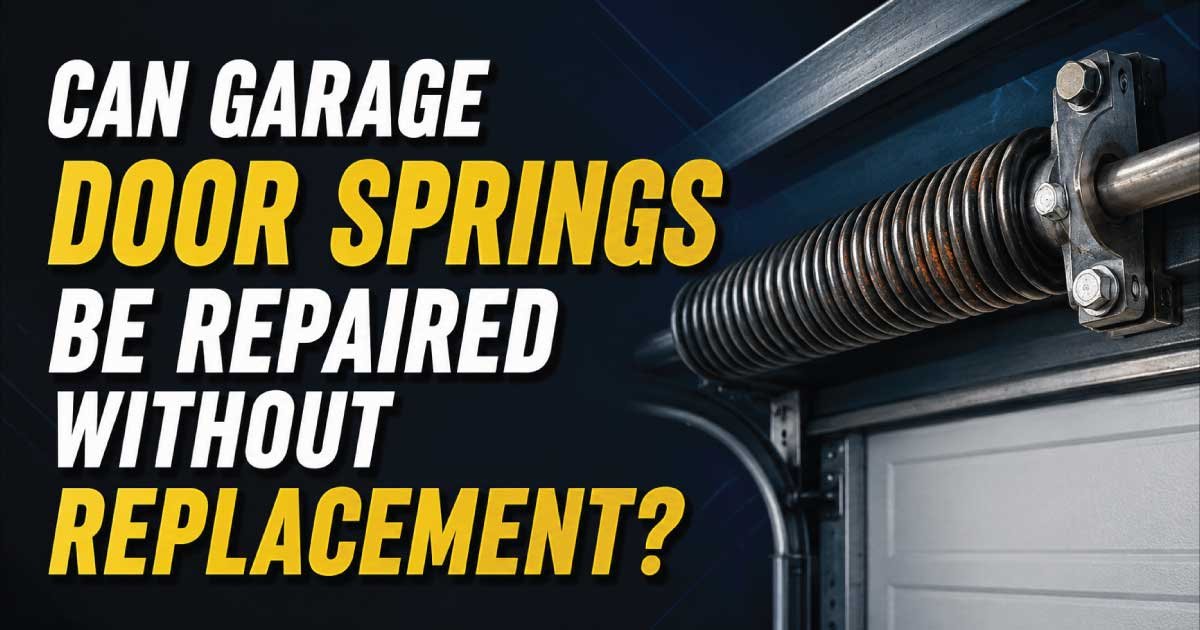
Garage door springs are one of the most important parts of your garage door system. They carry most of the door’s weight, allowing it to open and close smoothly with minimal effort. When a spring starts to fail, homeowners often wonder, can garage door springs be repaired without replacement? The answer depends on the type of damage, the condition of the springs, and, most importantly, whether a repair can be completed safely.
In many situations, garage door spring problems develop gradually. You might notice unusual noises, a heavy door, uneven movement, or gaps in the spring before a complete failure occurs. Catching these warning signs early may allow you to correct related issues such as poor lubrication, loose hardware, or balance problems before they cause additional damage. However, a broken spring itself usually cannot be safely repaired and often requires replacement.
This repair guide explains how garage door springs work, what warning signs to watch for, the most common causes of failure, essential safety tips, the tools used during inspection, and a logical troubleshooting process. By the end of this guide, you’ll know when a simple adjustment may solve the problem and when professional repair is the safest choice.
Common Signs and Symptoms
Garage door spring problems rarely appear without warning. Paying attention to small changes in how your garage door operates can help you identify developing issues before they become expensive or dangerous. While some symptoms point to simple maintenance needs, others indicate that the spring has reached the end of its service life.
Common warning signs include:
- The garage door feels unusually heavy when lifted manually.
- The automatic opener struggles to lift the door.
- The door opens only a few inches before stopping.
- The garage door closes too quickly.
- Loud banging or snapping noises come from the garage.
- One side of the door rises faster than the other.
- The door appears crooked while moving.
- Visible gaps appear in the spring coils.
- The cables become loose or come off the drum.
- The opener motor runs, but the door barely moves.
- Jerky or uneven door movement during operation.
- Squeaking, grinding, or popping sounds while opening or closing.
Practical example:
If your garage door opener suddenly sounds louder than usual and the door only opens halfway, avoid forcing it. A weakened torsion spring may no longer be supporting the door’s weight, causing unnecessary strain on the opener.
Ignoring these symptoms can lead to additional problems, including damaged cables, bent tracks, worn rollers, or a burned-out garage door opener.
How the Appliance or System Normally Works
Understanding how garage door springs normally function makes troubleshooting much easier. Springs do not lift the door by themselves. Instead, they store mechanical energy and release it gradually, counterbalancing the door’s weight so that both manual lifting and electric openers require very little force.
There are two primary spring systems:
Torsion Springs
Torsion springs are mounted above the garage door on a metal shaft.
They work by twisting under tension as the door closes. When the door opens, the stored energy unwinds, helping lift the door evenly.
Advantages include:
- Smooth operation
- Longer lifespan
- Better balance
- Greater lifting power
Extension Springs
Extension springs are installed along both horizontal tracks.
Instead of twisting, they stretch as the door closes and contract as it opens.
These systems are commonly found on older residential garage doors but generally wear out sooner than torsion springs.
During normal operation:
- The opener begins lifting the door.
- Springs release stored tension.
- Cables transfer lifting force.
- Rollers move smoothly inside the tracks.
- The door remains balanced throughout travel.
A properly balanced garage door should stay in place when lifted halfway manually. If it quickly falls or shoots upward, the spring system is no longer working correctly.
Most Common Reasons This Problem Happens
Garage door springs operate under tremendous tension every day. Even high-quality springs eventually wear out. Understanding the most common causes helps you determine whether you’re dealing with a maintenance issue, a minor adjustment, or a situation requiring complete spring replacement.
Normal Wear and Tear
The most common cause is simply age.
Most residential springs are rated for approximately 10,000 to 20,000 opening and closing cycles. A family using the garage several times a day can reach that limit within seven to ten years.
Symptoms include:
- Slower door movement
- Increasing noise
- Reduced lifting power
- Heavy manual operation
How to identify it:
- No visible damage elsewhere
- Springs appear rusty or fatigued
- Door balance gradually worsens over time
Rust and Corrosion
Rust increases friction between the spring coils, causing uneven movement and accelerating metal fatigue.
Symptoms include:
- Squeaking
- Grinding sounds
- Visible orange or brown corrosion
- Rough spring movement
Inspection tip:
Look closely at the spring coils with the door closed. Surface rust often indicates inadequate maintenance.
Poor Lubrication
Garage door springs require periodic lubrication to reduce friction.
Without lubrication:
- Springs wear faster.
- Noises increase.
- Tension becomes uneven.
- Additional strain is placed on the opener.
Diagnosis:
If the springs appear dry and noisy but otherwise intact, lubrication may restore smoother operation. However, lubrication cannot repair cracked or broken springs.
Improper Spring Size
Not every spring is designed for every garage door.
If incorrect springs were installed previously:
- The opener works harder.
- Springs wear out early.
- Door balance becomes inconsistent.
Signs include:
- Door refuses to stay halfway open.
- Uneven lifting.
- Frequent opener overload.
Poor Door Balance
A garage door should remain balanced throughout its movement.
When balance changes because of cable wear, roller problems, or track issues, the springs compensate by working harder than intended.
Symptoms include:
- Jerky operation
- Door drifting downward
- Uneven movement
Inspection involves disconnecting the opener and carefully testing manual balance.
Broken Spring
A broken spring is usually obvious.
Typical symptoms:
- Loud bang heard inside the garage
- Large gap visible in the spring
- Door becomes extremely heavy
- Opener cannot lift the door
A broken torsion spring almost always requires replacement rather than repair.
Loose or Damaged Hardware
Sometimes the spring itself remains functional while surrounding hardware causes similar symptoms.
Check for:
- Loose mounting brackets
- Worn bearing plates
- Loose cable drums
- Damaged lift cables
Correcting these issues may restore proper operation if the springs themselves remain in good condition.
Also Read:
Safety Precautions Before Troubleshooting
Garage door springs are among the most dangerous components found in a typical home. They store enough mechanical energy to cause severe injuries if handled incorrectly. Before inspecting or attempting any troubleshooting, make safety your highest priority.
Follow these precautions before beginning any diagnosis:
- Disconnect the automatic garage door opener.
- Unplug the opener from electrical power.
- Keep children and pets away from the work area.
- Never stand directly beneath a partially open garage door.
- Wear safety glasses.
- Wear durable work gloves.
- Use a stable ladder placed on level ground.
- Keep hands away from spring coils during inspection.
- Do not loosen winding cones on torsion springs.
- Never remove lift cables while springs remain under tension.
- Avoid using damaged or undersized tools.
- If the door appears severely unbalanced, stop troubleshooting immediately.
Important safety warning:
A broken garage door spring should never be repaired by welding, clamping, or attempting to reconnect broken metal. Springs operate under precise tension, and improvised repairs can fail without warning.
DIY homeowners can safely perform inspections, lubrication, and simple maintenance. Spring tension adjustments and spring replacement should generally be left to trained technicians with the correct winding bars and safety equipment.
Tools Required
Having the proper tools makes inspection easier while reducing the risk of accidental damage. The following tools are typically sufficient for basic troubleshooting and preventive maintenance.
| Tool | Purpose |
|---|---|
| Safety glasses | Protect eyes during inspection |
| Work gloves | Protect hands from sharp edges and cables |
| Step ladder | Reach springs and hardware safely |
| Flashlight | Inspect dark areas above the door |
| Tape measure | Measure spring dimensions if needed |
| Garage door lubricant | Reduce friction on springs and rollers |
| Adjustable wrench | Check loose mounting hardware |
| Socket set | Tighten brackets and bolts |
| Level | Verify track alignment |
| Clean cloth | Remove dirt and excess lubricant |
Avoid using screwdrivers or improvised metal rods as substitutes for professional winding bars when working around torsion springs.
Step-by-Step Troubleshooting Guide
Before assuming the springs need replacement, work through a systematic inspection. Many garage door problems share similar symptoms, and checking each component in order helps you avoid unnecessary repairs.
1. Inspect the Springs
Look closely for visible damage.
Why it matters:
Broken, stretched, or separated coils immediately indicate spring failure.
Expected result:
Springs should appear intact without gaps or major rust.
Next step:
If a spring is broken, stop troubleshooting and arrange for replacement.
2. Check Door Balance
Disconnect the opener using the emergency release cord.
Carefully raise the door halfway by hand.
Why it matters:
Balance reveals whether the springs are still providing adequate lifting force.
Expected result:
The door should remain near the halfway position.
Next step:
If it rapidly falls or rises, the spring system requires further attention.
3. Listen During Operation
Reconnect the opener if safe to do so.
Operate the door while listening carefully.
Why it matters:
Different noises often point toward specific problems.
Expected result:
Operation should be smooth and relatively quiet.
Next step:
Persistent squeaks may suggest lubrication needs, while loud snapping sounds usually indicate spring damage.
4. Examine the Lift Cables
Inspect both cables from top to bottom.
Why it matters:
Loose or damaged cables often accompany failing springs.
Expected result:
Cables should remain tight and evenly wound.
Next step:
If cables have slipped off the drum, avoid operating the door until repairs are completed.
5. Inspect Rollers and Tracks
Look for obstructions, bent tracks, or damaged rollers.
Why it matters:
Track problems can mimic spring failures.
Expected result:
Rollers should move freely without binding.
Next step:
Remove debris and tighten loose track hardware if necessary.
6. Lubricate Moving Parts
Apply garage door lubricant to the springs, rollers, hinges, and bearings.
Why it matters:
Proper lubrication reduces friction and extends component life.
Expected result:
The door should move more smoothly with reduced noise.
Next step:
If symptoms remain unchanged after lubrication, continue diagnosing the spring system instead of adding more lubricant.
Also Read:
Quick Diagnosis Table
The following table summarizes common symptoms and the most likely causes to help narrow down the problem before deciding whether repair or replacement is necessary.
| Symptom | Possible Cause | Recommended Solution |
|---|---|---|
| Door feels very heavy | Broken or weakened spring | Inspect springs and replace if broken |
| Loud bang from garage | Spring snapped | Stop using the door and replace the spring |
| Door opens unevenly | Uneven spring tension or cable issue | Inspect cables and spring system |
| Door won’t stay halfway open | Incorrect spring tension or worn springs | Perform balance test and seek professional adjustment if needed |
| Squeaking during operation | Dry or rusty springs | Clean and lubricate the springs |
| Opener struggles to lift door | Weak springs or door imbalance | Test balance before inspecting the opener |
| Visible gap in torsion spring | Broken spring | Replace the spring immediately |
| Loose lift cables | Spring failure or cable issue | Do not operate the door until inspected |
How to Fix Each Common Cause
Now that you’ve identified the likely source of the problem, the next step is determining whether it can be repaired safely or whether replacement is the only practical solution. Some issues affecting garage door springs are minor maintenance problems, while others involve components under extreme tension that should never be repaired by homeowners.
Dry or Noisy Springs
If the springs are intact but make squeaking or grinding noises, lubrication is often the solution.
How to fix it:
- Close the garage door completely.
- Disconnect the automatic opener.
- Wipe dirt and old grease from the springs.
- Apply a garage door lubricant designed for metal moving parts.
- Open and close the door several times to distribute the lubricant evenly.
Avoid using heavy grease because it attracts dust and debris.
Surface Rust
Light surface corrosion can sometimes be managed before it causes permanent damage.
Repair method:
- Clean loose rust with a soft wire brush.
- Wipe away debris.
- Apply a garage door lubricant that helps resist moisture.
- Inspect the spring every few months for worsening corrosion.
If deep pitting or cracks are visible, replacement is the safer option.
Loose Mounting Hardware
Loose brackets, bearing plates, or cable drums can affect how the spring system operates.
How to fix it:
- Tighten accessible bolts using the correct wrench.
- Replace damaged fasteners.
- Inspect nearby components for signs of movement or wear.
Do not loosen any hardware attached directly to a loaded torsion spring.
Door Balance Problems
Sometimes the springs remain in good condition, but the garage door becomes unbalanced because of worn rollers, damaged hinges, or cable issues.
Repair method:
- Replace worn rollers if necessary.
- Tighten loose hinges.
- Clean the tracks.
- Confirm both lift cables remain properly seated.
If the balance problem remains after these repairs, the spring tension may require adjustment by a qualified technician.
Worn Extension Springs
Extension springs occasionally lose strength gradually rather than breaking suddenly.
Possible signs include:
- Slow opening
- Uneven lifting
- Door drifting downward
Although minor hardware associated with extension springs can sometimes be repaired, weakened springs themselves should generally be replaced in matched pairs to maintain balanced lifting.
Broken Torsion Springs
This is the question most homeowners ask:
Can garage door springs be repaired without replacement?
In the case of a broken torsion spring, the answer is almost always no.
A torsion spring cannot safely be welded, clamped, or otherwise repaired because:
- The metal has already failed from fatigue.
- Any repair weakens the spring further.
- The spring will no longer provide accurate tension.
- Failure under load can cause serious injury.
Professional replacement using the correct spring size is the only reliable solution.
Damaged Lift Cables
A cable problem may appear to be a spring problem.
If a cable has:
- Frayed strands
- Broken wires
- Pulled off the drum
Replace the cable instead of attempting to reuse it.
Since cable replacement often involves releasing spring tension, many homeowners choose professional repair for safety.
Advanced Troubleshooting
Some garage door problems are less obvious because several components work together. When the basic inspection doesn’t reveal the cause, a more detailed diagnosis may be necessary.
Incorrect Spring Size
Replacement springs occasionally have the wrong:
- Wire diameter
- Length
- Inside diameter
- Weight rating
Symptoms include:
- Door feels too heavy.
- Door rises by itself.
- Opener strains constantly.
Matching the spring to the exact door weight is essential for safe operation.
Bent Shaft
A slightly bent torsion shaft may create uneven spring tension.
Signs include:
- Door shakes during movement.
- Uneven cable winding.
- One side lifts faster.
Inspection usually requires removing spring tension, making this a professional-level repair.
Worn Bearings
Center and end bearings allow the torsion shaft to rotate smoothly.
When bearings wear out:
- Grinding develops.
- Increased resistance appears.
- Springs wear faster.
Replacing inexpensive bearings can sometimes prevent premature spring failure.
Damaged Cable Drums
Cable drums guide the lift cables evenly.
Inspect for:
- Cracks
- Bent edges
- Loose set screws
- Uneven cable grooves
Damaged drums should be replaced before installing new springs.
Garage Door Opener Problems
A failing opener sometimes mimics spring failure.
Check whether:
- The opener hums but does not lift.
- The travel limits are incorrect.
- Force settings are improperly adjusted.
- The drive gear has worn out.
Always verify spring balance before assuming the opener is defective.
When Repair Is Not Worth It
Not every garage door spring problem should be repaired. In many cases, replacement is safer, more reliable, and less expensive over the long term.
Replacement is usually the better choice when:
- The spring is broken.
- Multiple coils are cracked.
- The spring has exceeded its expected cycle life.
- Deep corrosion has weakened the metal.
- Previous repair attempts have altered the spring.
- One spring has failed on a two-spring system.
Many technicians recommend replacing both springs together on dual-spring doors because the second spring has usually experienced similar wear.
Continuing to use old springs may lead to:
- Opener damage
- Cable failure
- Crooked door movement
- Unexpected breakdowns
Replacing worn springs before complete failure often reduces the risk of additional repairs.
Also Read:
Preventive Maintenance Tips
Routine maintenance is the best way to maximize spring life and reduce unexpected failures. Most inspections take only a few minutes and can help identify developing problems before they become serious.
Good preventive maintenance includes:
- Lubricate springs every three to six months with a garage door lubricant.
- Visually inspect springs for rust, gaps, or deformation.
- Listen for new noises during operation.
- Tighten accessible hardware periodically.
- Keep tracks clean and free of debris.
- Replace worn rollers before they create additional strain.
- Test door balance several times each year.
- Avoid slamming the garage door shut.
- Schedule professional inspections for older garage door systems.
If your household uses the garage as the primary entrance, consider upgrading to high-cycle springs during the next replacement. Although they cost more initially, they generally last significantly longer under frequent use.
Common Mistakes to Avoid
Many garage door repairs become more expensive because homeowners unintentionally make the original problem worse.
Avoid these common mistakes:
- Ignoring early warning signs.
- Continuing to use a door with a broken spring.
- Applying excessive lubricant.
- Using household grease instead of garage door lubricant.
- Attempting to weld a broken spring.
- Replacing only one spring on a dual-spring system when both are equally worn.
- Adjusting torsion spring tension without proper training.
- Operating the opener repeatedly when the door will not lift.
- Using incorrect replacement springs.
- Skipping regular maintenance inspections.
Taking a cautious approach protects both your garage door system and your personal safety.
When to Call a Professional
Many garage door maintenance tasks are suitable for homeowners, but spring work requires careful judgment. The stored energy inside torsion and extension springs creates hazards that ordinary household tools cannot safely manage.
Professional repair is strongly recommended if:
- A torsion spring has broken.
- Spring tension requires adjustment.
- Lift cables have come off the drums.
- The garage door is severely unbalanced.
- The torsion shaft is bent.
- You notice cracked winding cones.
- Multiple components have failed simultaneously.
- The door weighs too much to lift safely.
- You are unsure which spring your system requires.
A qualified garage door technician has specialized winding bars, measuring tools, replacement parts, and experience to complete repairs safely while ensuring the door remains properly balanced afterward.
Estimated Repair Costs
Repair costs vary depending on your location, garage door size, spring type, and labor rates. The table below provides typical price ranges for residential garage door repairs.
| Repair | Estimated Cost | DIY or Professional |
|---|---|---|
| Spring lubrication | $10–$20 | DIY |
| Rust cleaning and maintenance | $10–$40 | DIY |
| Roller replacement | $50–$150 | DIY or Professional |
| Lift cable replacement | $100–$250 | Professional |
| Extension spring replacement | $150–$300 | Professional |
| Torsion spring replacement | $200–$450 | Professional |
| Replace both torsion springs | $300–$600 | Professional |
| Bearing replacement | $120–$250 | Professional |
| Complete garage door tune-up | $100–$250 | Professional |
Final Thoughts
The answer to can garage door springs be repaired without replacement depends on the specific problem. Minor issues such as poor lubrication, light rust, loose hardware, or balance-related maintenance can often be corrected without installing new springs. However, once a spring has cracked, stretched beyond its design limits, or broken, replacement is almost always the only safe and dependable solution.
The key to avoiding costly repairs is early diagnosis. Regular inspections, proper lubrication, and paying attention to unusual noises or changes in door movement can help identify problems before they become emergencies. Understanding how the spring system works also makes it easier to distinguish between simple maintenance tasks and repairs that require specialized equipment.
When in doubt, prioritize safety over convenience. Garage door springs store a tremendous amount of energy, and improper repairs can result in serious injuries or additional property damage. By following the troubleshooting steps, practicing preventive maintenance, and calling a qualified professional when necessary, you can keep your garage door operating smoothly, extend the life of its components, and ensure reliable performance for years to come.

Engineer Ali Usman is a professional garage door expert and author at FixFasty, with over 10 years of hands-on experience in garage door systems and mechanical maintenance. He writes clear, step-by-step guides on garage door repairs, parts, and safety practices, helping homeowners fix problems correctly and maintain smooth, secure, and long-lasting garage door performance.