
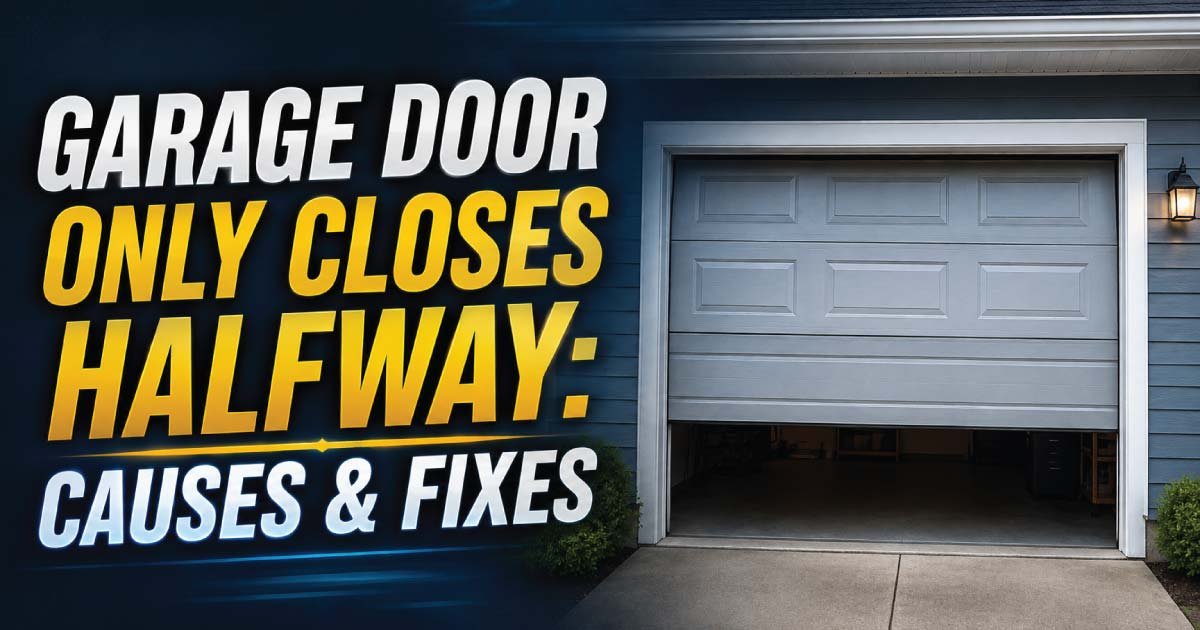
When a garage door only closes halfway, it is usually a sign that something is interfering with the door’s travel, balance, sensors, or opener settings. The problem may be as simple as blocked safety sensors or debris in the tracks, but it can also point to worn rollers, damaged springs, incorrect travel limits, or an issue with the garage door opener.
A garage door that stops halfway should not be forced shut. Continuing to operate it when a component is damaged can turn a minor repair into a much more expensive problem and may create a safety hazard.
The good news is that several common causes are easy to identify. This guide explains why a garage door stops halfway, what you can safely check yourself, when an adjustment may solve the problem, and when it is better to call a professional garage door technician.
Why Does My Garage Door Only Close Halfway?
A garage door that closes partway and then stops or reverses can have several possible causes. The opener relies on multiple components working together, including the tracks, rollers, springs, cables, sensors, and motor.
The most common causes include:
- Obstructed or misaligned safety sensors
- Dirt or debris in the garage door tracks
- Damaged or binding rollers
- Incorrect opener travel-limit settings
- An improperly balanced garage door
- Broken or weakened torsion or extension springs
- Damaged lift cables
- Excessive friction or resistance
- A malfunctioning garage door opener
- Cold weather or physical changes affecting door movement
The exact symptom can provide an important clue. For example, a door that reaches the same halfway point every time may have a travel-limit or obstruction issue, while a door that moves unevenly or appears unusually heavy may have a spring, cable, or balance problem.
Common Causes of a Garage Door Stopping Halfway
1. Blocked or Misaligned Safety Sensors
Modern automatic garage doors typically use photoelectric safety sensors near the bottom of the tracks. These sensors communicate with each other using an invisible beam. If the beam is interrupted, the opener may stop the door or reverse it to prevent injury or property damage.
Check whether:
- Both sensor lenses are clean.
- Nothing is blocking the sensor path.
- The sensors are facing each other.
- Their mounting brackets have not been bumped or bent.
- The indicator lights appear normal according to your opener’s instructions.
Dust, cobwebs, stored items, or accidental impacts can interfere with sensor operation.
Cleaning the lenses with a soft, dry cloth and making sure nothing blocks the sensors is a reasonable first step. Avoid bypassing or disabling the safety sensors.
2. Dirty, Bent, or Obstructed Tracks
Garage door tracks guide the rollers as the door moves up and down. If a track becomes bent, clogged with debris, or misaligned, the rollers may encounter resistance and cause the door to stop.
Look for:
- Dirt or small objects inside the track
- Visible dents or bends
- Loose mounting hardware
- Gaps or unusual alignment
- Rollers rubbing against the track
Do not try to straighten a severely bent track while the door is under tension. A professional should handle significant track damage because the door can be heavy and difficult to control.
3. Worn or Damaged Rollers
Garage door rollers move inside the tracks and allow the door sections to travel smoothly. Worn rollers can create excessive friction, noise, vibration, or resistance.
If you hear grinding, scraping, or squealing as the door approaches the halfway point, the rollers may be contributing to the problem.
Nylon rollers can eventually wear out, while steel rollers may become noisy or develop damaged bearings. Replacing severely worn rollers can restore smoother door operation, but roller replacement can involve working around a heavy moving door, so use caution.
4. Incorrect Travel-Limit Settings
Your garage door opener has travel limits that tell the motor how far the door should move in each direction. If the closing limit is incorrectly programmed, the opener may believe the door has reached its intended position before it is fully closed.
This can happen after:
- Installing a new opener
- Replacing opener components
- Accidentally changing the settings
- Performing certain maintenance procedures
- Experiencing an electrical or control issue
Travel-limit adjustment procedures vary significantly by opener model. Before changing them, consult the manufacturer’s manual.
If the door consistently stops at approximately the same location without an obvious physical obstruction, incorrect travel settings are worth investigating.
5. An Unbalanced Garage Door
A properly functioning garage door should be reasonably balanced by its spring system. The opener is designed to move the door, not compensate for a severely unbalanced or excessively heavy door.
Signs of an imbalance include:
- The door feels unusually heavy when operated manually.
- One side rises faster than the other.
- The door falls or rises unexpectedly.
- The opener struggles or sounds strained.
- The door stops at different points.
- The door appears crooked during operation.
If the door is difficult to lift manually or does not remain in a stable position when appropriate, the springs may require professional inspection.
6. Broken or Weak Garage Door Springs
Springs counterbalance the weight of the garage door. When a torsion or extension spring breaks or loses significant tension, the opener may struggle to move the door.
A broken spring may be obvious: you might see a separation in a torsion spring above the door or a disconnected extension spring along the sides.
Other warning signs include:
- A loud snapping sound before the problem began
- A visibly broken spring
- A door that suddenly feels much heavier
- A garage door that opens only slightly
- An opener that hums but cannot move the door properly
Do not attempt to replace or adjust garage door springs yourself unless you have the appropriate professional training and equipment. Springs store substantial mechanical energy and can cause severe injuries if handled incorrectly.
7. Damaged Lift Cables
Lift cables work with the spring system to raise and lower the garage door. A frayed, loose, or disconnected cable can cause the door to become crooked or bind in the tracks.
If one side of the door appears lower than the other, stop operating it and arrange for an inspection.
A cable problem can place additional stress on the rollers, tracks, panels, and opener.
8. Excessive Friction or Resistance
Sometimes the opener itself is functioning correctly, but the garage door encounters too much resistance.
Possible sources include:
- Dry or worn rollers
- Tight or damaged hinges
- Track problems
- Rust or corrosion
- Debris
- Damaged door sections
- Poor alignment
An automatic opener may interpret unusually high resistance as an obstruction and stop or reverse the door.
Garage Door Halfway Down: What the Symptom Tells You
The point at which the door stops can help narrow down the cause.
| Symptom | Possible Cause | What to Check |
|---|---|---|
| Stops at exactly the same point | Travel limit or physical obstruction | Tracks, opener settings |
| Stops and reverses | Safety sensor or resistance issue | Sensors, tracks, rollers |
| Moves unevenly | Cable, spring, roller, or track problem | Door alignment |
| Makes grinding noises | Worn rollers or track issues | Rollers and tracks |
| Opener runs but door barely moves | Spring or mechanical problem | Door balance and springs |
| Door feels very heavy manually | Broken or weak springs | Professional inspection |
| One side hangs lower | Cable or track problem | Stop using the door |
| Works intermittently | Sensor, wiring, opener, or obstruction | Sensors and controls |
This table is only a starting point. Several problems can produce similar symptoms, so a professional inspection may be necessary for an accurate diagnosis.
How to Troubleshoot a Garage Door That Only Closes Halfway
Step 1: Stop and Inspect the Door
Do not repeatedly press the remote while the door is struggling. Watch the door during one controlled cycle, if it can operate safely.
Look for:
- Jerky movement
- Unusual noises
- A crooked door
- Visible damage
- A point where the door consistently binds
If you notice a broken spring, loose cable, severely bent track, or unstable door, stop troubleshooting and contact a garage door professional.
Step 2: Check the Safety Sensors
Inspect the sensors near the bottom of the door tracks.
Clean their lenses and remove objects that could block their beam. Make sure they have not been accidentally knocked out of position.
If the sensors appear damaged or their wiring is loose, professional repair may be appropriate.
Step 3: Inspect the Tracks
With the door stationary, visually inspect the tracks for obvious obstructions or damage.
You can remove loose dirt and debris carefully, but do not force a bent track back into position. Also avoid adjusting track hardware unless you understand the door’s mechanical system.
Step 4: Look at the Rollers and Hinges
Check for rollers that are visibly damaged, cracked, excessively worn, or sitting incorrectly in the track.
Also look at the hinges connecting the door sections. A damaged hinge can increase resistance as the door travels.
Step 5: Check the Opener’s Travel Settings
If the door stops consistently at the same location and the mechanical components look normal, consult the opener’s manual for travel-limit instructions.
Different manufacturers use different controls and programming procedures, so avoid following generic adjustment instructions that do not match your specific model.
Step 6: Consider Door Balance
If you are trained and the door system is clearly safe to handle, manual balance can provide useful information. However, a garage door can be extremely heavy, and the springs are under high tension.
If you are uncertain, do not disconnect the opener or attempt to manipulate the spring system just to perform a test. Have a qualified technician inspect it instead.
Can I Fix a Garage Door That Stops Halfway Myself?
Some basic troubleshooting is appropriate for homeowners, particularly when the issue is an obvious obstruction or dirty safety sensor.
Generally safer DIY tasks include:
- Removing objects from the door’s path
- Cleaning safety-sensor lenses
- Clearing loose debris around accessible track areas
- Checking whether the opener has power
- Inspecting the door for obvious visible damage
- Consulting the manufacturer’s manual
More advanced repairs should usually be left to a professional:
- Spring replacement or adjustment
- Cable replacement
- Major track alignment
- Door-panel replacement
- Significant structural repairs
- Opener motor or electrical repairs
- Repairs involving substantial stored spring tension
The important distinction is between inspection and adjustment versus working on components under significant mechanical tension.
When to Call a Garage Door Professional
A professional inspection is recommended when the cause is not obvious or when the door shows signs of mechanical damage.
Call a technician if:
- The garage door is crooked.
- A spring appears broken.
- A cable is frayed, loose, or disconnected.
- The door is unusually heavy.
- The track is badly bent.
- The opener makes loud or unusual noises.
- The door repeatedly stops despite basic troubleshooting.
- The opener reverses for no obvious reason.
- You smell burning or notice electrical problems.
- The door falls or moves unexpectedly.
A technician can inspect the entire system rather than treating only the symptom. This matters because a garage door opener that stops halfway may be reacting to an underlying mechanical problem.
Garage Door Stops Halfway When Closing but Opens Normally
This particular symptom can narrow the possibilities.
If the door opens normally but stops or reverses during closing, start by checking the safety sensors and the area around the door.
A sensor problem is especially likely when the opener reverses the door after it begins closing. However, excessive resistance, incorrect force or travel settings, track problems, and opener faults can produce similar behavior.
If the door closes partway and then reverses, pay attention to whether:
- It reaches the same position every time.
- The opener lights flash.
- The motor continues running.
- The door physically binds.
- The door moves smoothly until the stopping point.
These details can help identify whether the issue is related to the opener’s controls or the door’s mechanical components.
Garage Door Only Closes Halfway and Then Opens Again
A garage door that closes halfway and immediately opens again often indicates that the opener believes something is obstructing the door.
The most common areas to investigate are:
- Safety sensors
- Door tracks
- Rollers
- Travel limits
- Excessive closing resistance
Check the sensor alignment first because it is relatively simple and does not require disassembling the door.
If the sensors appear fine, inspect the tracks and rollers for anything that could increase resistance. If there is no obvious cause, the opener may need professional diagnosis.
How Much Does It Cost to Fix a Garage Door That Stops Halfway?
The repair cost depends heavily on the underlying problem. A homeowner who only needs to remove an obstruction may spend nothing, while a broken spring, damaged cable, replacement rollers, track repair, or new opener can require a more substantial investment.
The cost can vary based on:
- Garage door type and size
- Opener model
- Replacement-part quality
- Local labor rates
- Extent of damage
- Whether multiple components are affected
It is better to diagnose the problem before comparing repair prices. For example, replacing the opener may not solve a problem caused by a damaged spring or binding track.
When requesting a quote, ask the technician to explain what failed, why it failed, and which parts need repair or replacement.
How to Prevent Garage Door Problems in the Future
Routine maintenance can reduce wear and help identify problems before they become serious.
Perform Regular Visual Inspections
Every few months, look at the:
- Springs
- Cables
- Rollers
- Hinges
- Tracks
- Door panels
- Safety sensors
You are not necessarily looking for something to repair yourself. The goal is to notice changes such as fraying, cracks, corrosion, looseness, or unusual wear.
Keep the Door’s Path Clear
Avoid storing objects where they could interfere with the door’s movement or sensor beam.
Make sure bicycles, boxes, tools, and other garage items do not obstruct the door or its tracks.
Pay Attention to Changes in Operation
A garage door rarely develops a major problem without showing some warning signs.
Watch for:
- Increasing noise
- Slower movement
- Shaking
- Uneven travel
- Repeated reversals
- New grinding or popping sounds
- A door that feels heavier
Addressing unusual behavior early can prevent additional damage.
Use the Correct Lubricant
Some moving garage door components benefit from periodic lubrication, but the correct product and application depend on the component and manufacturer’s recommendations.
Do not use excessive lubricant or apply products indiscriminately to tracks. The tracks need to remain clean so the rollers can travel properly.
Garage Door Opener vs. Garage Door: Which Is Actually the Problem?
It is easy to assume that a door that stops halfway has a faulty opener. In reality, the opener is often responding to a problem elsewhere in the system.
| Area | Typical Warning Signs |
|---|---|
| Safety sensors | Reversing, flashing lights, failure to close |
| Tracks | Binding, scraping, uneven movement |
| Rollers | Grinding, squeaking, vibration |
| Springs | Heavy door, inability to lift normally |
| Cables | Crooked or uneven door |
| Hinges | Increased friction or damaged sections |
| Opener | Motor issues, control problems, abnormal operation |
A professional diagnosis should consider the complete garage door system rather than immediately replacing the opener.
Frequently Asked Questions
Why does my garage door stop halfway down?
A garage door may stop halfway because of a blocked safety sensor, track obstruction, damaged roller, excessive resistance, incorrect travel limits, or a spring or cable problem. If it always stops at the same location, inspect for both a physical obstruction and an opener travel-setting issue.
Why will my garage door open but not close all the way?
Safety sensors are one of the first things to check. If the sensors are blocked, dirty, misaligned, or damaged, the opener may prevent the door from closing. Mechanical resistance and opener settings can also cause this symptom.
Should I adjust the garage door spring myself?
No. Garage door springs store substantial energy and can cause serious injury if they are improperly adjusted, removed, or replaced. Spring-related repairs should be handled by a qualified garage door professional.
Why does my garage door reverse halfway down?
Reversing can occur when the opener detects an obstruction, the safety sensors are not operating correctly, or the door encounters excessive resistance. Check for obvious sensor and track issues first, then arrange for professional service if the problem continues.
Can a dirty garage door track cause the door to stop?
Yes. Debris or damage can increase resistance and interfere with roller movement. Remove loose debris that is safely accessible, but have severely bent or misaligned tracks professionally repaired.
Final Thoughts
When a garage door only closes halfway, the cause can range from a simple sensor obstruction to a serious mechanical problem involving the springs, cables, tracks, or opener. Start with safe visual checks: inspect the safety sensors, clear obvious obstructions, and look for visible track or roller problems.
Do not force the door closed or attempt to adjust high-tension springs and cables yourself. If the door is crooked, unusually heavy, damaged, or behaving unpredictably, stop using it and contact a qualified garage door technician.
A timely inspection can identify the underlying cause, protect the opener from unnecessary strain, and help restore smooth, reliable garage door operation.

Engineer Ali Hasan is a garage door expert and the founder of FixFasty. With over 16 years of experience in mechanical systems and home maintenance, he provides practical, step-by-step guides on garage door installation, repairs, and maintenance, helping homeowners keep their garage doors safe, reliable, and long-lasting.