
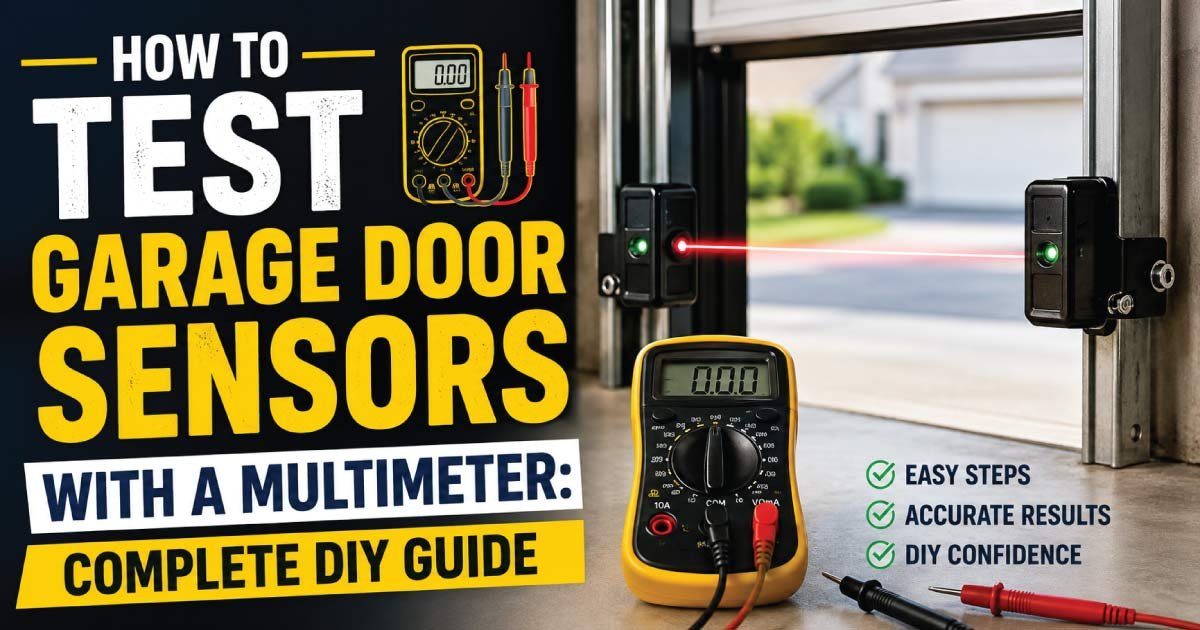
Garage door safety sensors are one of the most important components of a modern garage door system. These small devices prevent the garage door from closing when an object, pet, vehicle, or person is in the door’s path. When sensors stop working correctly, your garage door may refuse to close, reverse unexpectedly, or display flashing lights on the opener.
If you’re experiencing garage door sensor problems, testing them with a multimeter is one of the most effective ways to diagnose the issue. A multimeter allows you to check voltage, continuity, and electrical connections to determine whether the sensors are functioning properly or need replacement.
In this guide, you’ll learn how to test garage door sensors with a multimeter safely and accurately, even if you’re not an experienced technician.
What Are Garage Door Sensors?
Garage door sensors, also called photo-eye sensors, are safety devices mounted near the bottom of the garage door tracks. One sensor sends an infrared beam while the other receives it.
When the beam is uninterrupted, the garage door operates normally. If something blocks the beam, the door automatically stops or reverses to prevent accidents.
Most garage door openers manufactured after 1993 are required to include safety sensors.
Signs Your Garage Door Sensors May Be Faulty
Before testing with a multimeter, look for common symptoms of sensor problems:
- Garage door won’t close completely
- Door closes partially then reverses
- Opener lights blink repeatedly
- Sensor LED lights are off
- Sensor lights are flashing
- Door only closes when holding the wall button
- Intermittent garage door operation
- Safety sensors appear misaligned
If cleaning and realigning the sensors doesn’t solve the issue, electrical testing is the next step.
Tools You will Need
Gather the following tools before starting:
- Digital multimeter
- Screwdriver set
- Safety gloves
- Flashlight
- Wire stripper (if needed)
- Electrical tape
- Ladder (if required)
A digital multimeter is recommended because it provides more accurate readings than analog models.
Safety Precautions Before Testing
Garage door systems contain electrical components that should be handled carefully.
Always:
- Disconnect power before handling wiring
- Keep hands dry
- Wear safety gloves
- Avoid touching exposed wires
- Follow manufacturer instructions
- Reconnect power only when voltage testing is required
Never attempt repairs on garage door springs or cables while working around the opener system.
Understanding Garage Door Sensor Wiring
Most garage door sensors use low-voltage wiring supplied by the garage door opener.
Typically:
- White wire = common
- White/black stripe wire = signal
The opener usually supplies between 4 and 12 volts DC to the sensors, depending on the manufacturer and model.
Understanding this wiring helps ensure accurate multimeter testing.
Step 1: Perform a Visual Inspection
Before using a multimeter, inspect the sensors carefully.
Check for:
- Dirty sensor lenses
- Loose wiring
- Damaged cables
- Corrosion on terminals
- Misaligned sensors
- Physical damage to sensor housing
Clean the lenses using a soft cloth and verify both sensors face each other directly.
Many sensor issues can be fixed without electrical testing.
Step 2: Check Sensor Indicator Lights
Most garage door sensors have LED indicator lights.
Observe both sensors:
Normal Condition
- Sending sensor: solid light
- Receiving sensor: solid light
Potential Problems
- No light
- Flashing light
- Dim light
- Intermittent light
If either sensor shows abnormal LED behavior, proceed with multimeter testing.
Step 3: Test Power Supply Voltage
One of the first electrical tests is verifying that the sensors receive power.
How to Test
- Set your multimeter to DC voltage.
- Restore power to the garage door opener.
- Locate the sensor wiring terminals.
- Place the black probe on the negative wire.
- Place the red probe on the positive wire.
- Record the reading.
Expected Reading
Most garage door sensors receive:
- 4V to 12V DC
Check your owner’s manual for exact specifications.
Results
Voltage Present
If the proper voltage is present, power delivery is likely not the issue.
No Voltage
Possible causes include:
- Faulty opener board
- Broken wiring
- Loose terminal connections
- Damaged power circuit
Repair wiring issues before replacing sensors.
Step 4: Test Sensor Wiring Continuity
Damaged wires are a common cause of sensor failure.
A continuity test checks whether electricity can travel through the wire properly.
How to Perform a Continuity Test
- Disconnect power.
- Remove sensor wires from the opener.
- Set the multimeter to continuity mode.
- Touch one probe to each end of the wire.
- Observe the reading.
Good Wire
- Multimeter beeps
- Reading close to 0 ohms
Bad Wire
- No beep
- Infinite resistance
- OL (open loop) display
Replace damaged wiring if continuity fails.
Step 5: Test Sensor Resistance
Some sensor faults can be identified through resistance measurements.
Procedure
- Disconnect sensor from the wiring.
- Set multimeter to resistance (Ohms).
- Touch probes to sensor terminals.
- Record resistance value.
What to Look For
A sensor showing:
- Extremely high resistance
- Infinite resistance
- No measurable value
may be defective.
Because resistance values vary by manufacturer, compare readings from both sensors whenever possible.
Large differences often indicate a faulty sensor.
Step 6: Check for Short Circuits
Short circuits can prevent sensors from operating correctly.
Testing for Shorts
- Disconnect sensor wiring.
- Set multimeter to continuity mode.
- Test between wire conductors.
Normal Result
- No continuity
Short Circuit Result
- Continuity detected
- Multimeter beeps
A shorted wire should be repaired or replaced immediately.
Step 7: Test Sensor Output Signal
Advanced troubleshooting may involve checking the sensor output.
Procedure
- Restore power.
- Set multimeter to DC voltage.
- Measure output terminals.
- Observe readings with beam aligned.
- Observe readings with beam blocked.
Expected Behavior
The voltage should change when:
- Beam is clear
- Beam is interrupted
No change may indicate a defective sensor.
Refer to manufacturer specifications for expected values.
Step 8: Verify Sensor Alignment
Many homeowners replace sensors unnecessarily when alignment is the real problem.
Check Alignment
- Sensors face each other directly
- Both mounted at equal height
- No obstacles in beam path
- Brackets securely attached
After alignment:
- Sensor lights should become solid
- Door should operate normally
Even a slight bump can knock sensors out of position.
Common Multimeter Readings and What They Mean
| Reading | Meaning |
|---|---|
| 4V–12V DC | Normal sensor power |
| 0V | No power reaching sensor |
| OL | Open circuit |
| Infinite resistance | Broken wire or faulty sensor |
| Near 0 ohms | Good continuity |
| No continuity beep | Damaged wire |
| Fluctuating voltage | Loose connection |
These readings help identify the exact source of the problem.
Troubleshooting Garage Door Sensor Problems
Sensor Lights Are Off
Possible causes:
- No power supply
- Broken wire
- Failed sensor
- Defective opener board
Sensor Lights Flash
Possible causes:
- Misalignment
- Dirty lenses
- Loose mounting bracket
Garage Door Won’t Close
Possible causes:
- Blocked sensor beam
- Failed sensor
- Wiring fault
- Opener logic board issue
Door Reverses Immediately
Possible causes:
- Sensor malfunction
- Electrical interference
- Alignment issue
Systematic testing helps isolate the problem quickly.
When Should You Replace Garage Door Sensors?
Replace sensors if:
- No voltage response is detected
- Sensor LEDs remain off despite proper power
- Internal damage is visible
- Resistance readings indicate failure
- Sensor output doesn’t change during testing
Most garage door sensors are relatively inexpensive compared to major garage door repairs.
Can You Test Garage Door Sensors Without a Multimeter?
Yes, although results are less precise.
Basic tests include:
- Cleaning sensor lenses
- Checking LED indicators
- Aligning sensors
- Blocking beam with an object
- Inspecting wiring visually
However, a multimeter provides definitive electrical readings and is the best diagnostic tool.
Preventing Future Sensor Problems
Regular maintenance reduces sensor failures.
Follow these tips:
- Clean sensor lenses monthly
- Check alignment regularly
- Secure loose wiring
- Protect sensors from impacts
- Keep tracks free of debris
- Inspect connections annually
Preventive maintenance can significantly extend sensor life.
My Experience Testing Garage Door Sensors
Over the years, I’ve found that most garage door sensor issues are not caused by failed sensors themselves. In many service calls, the real problem turned out to be loose wiring, dirty lenses, or slightly misaligned sensors after someone accidentally bumped them while moving equipment in the garage.
Whenever I troubleshoot a garage door that won’t close, I always start with a visual inspection before reaching for the multimeter. Once basic issues are ruled out, voltage and continuity testing quickly reveal whether the problem lies with the sensors, wiring, or opener. This step-by-step approach saves time, avoids unnecessary part replacements, and helps homeowners get their garage doors working again safely.
Conclusion
Knowing how to test garage door sensors with a multimeter can save you time, money, and frustration. By checking voltage, continuity, resistance, and sensor output, you can accurately determine whether the issue is caused by faulty sensors, damaged wiring, poor alignment, or a failing garage door opener.
Start with a visual inspection, verify power supply, test wiring continuity, and then move on to advanced electrical checks. In many cases, a simple adjustment or wire repair restores proper operation without replacing any parts.
If testing confirms that the sensors have failed, replacing them promptly ensures your garage door remains safe and fully functional for years to come.
Also Read:

Engineer Ali Hasan is a garage door expert and the founder of FixFasty. With over 16 years of experience in mechanical systems and home maintenance, he provides practical, step-by-step guides on garage door installation, repairs, and maintenance, helping homeowners keep their garage doors safe, reliable, and long-lasting.