
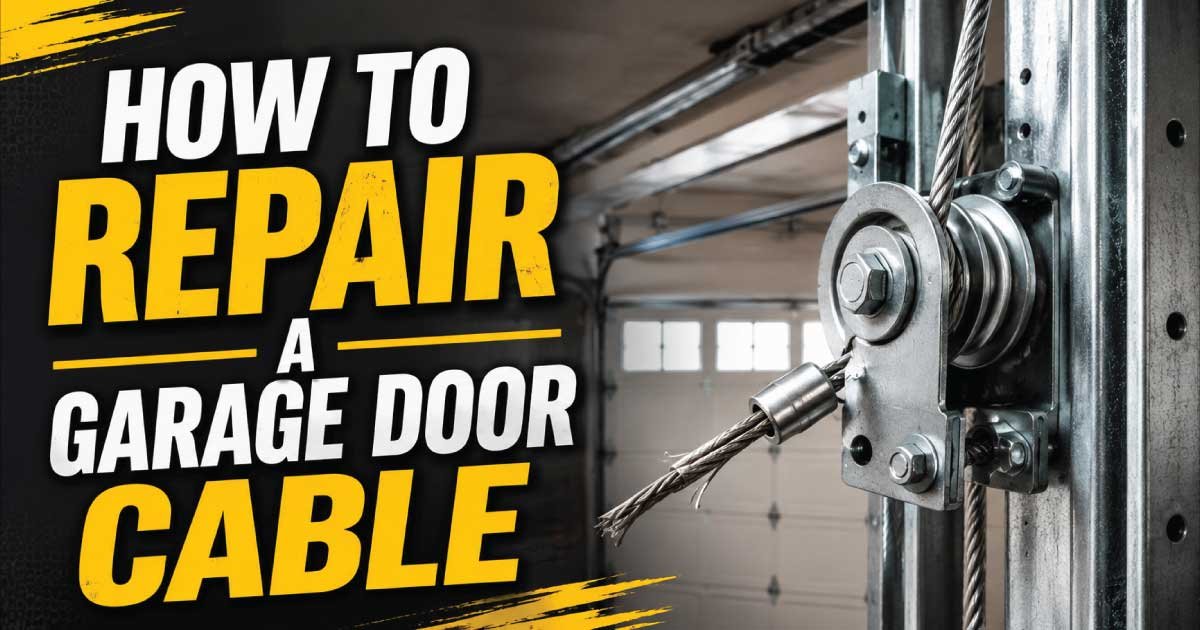
A broken or loose garage door cable can turn a simple daily task into a serious safety concern. These cables play a critical role in lifting and lowering the garage door by working alongside the torsion or extension springs. When a cable frays, slips off the drum, or snaps completely, the door may become uneven, get stuck halfway, or refuse to open altogether. In some cases, the door may even fall unexpectedly, creating a risk of injury and property damage.
Many homeowners assume the garage door opener is to blame when the real problem is a damaged cable. Understanding how the system works makes it much easier to recognize the warning signs before a minor issue turns into an expensive repair.
This comprehensive guide explains how to repair a garage door cable by first helping you identify the problem safely. You’ll learn how garage door cables function, what causes them to fail, which tools are commonly needed, and how to troubleshoot the issue step by step. Just as importantly, you’ll learn when a repair is suitable for a careful DIY homeowner and when professional service is the safest choice.
Common Signs and Symptoms
Garage door cable problems often begin with small warning signs before the cable completely fails. Recognizing these symptoms early can prevent further damage to the door, springs, tracks, and opener. Paying attention to unusual movements or noises can save both time and repair costs.
Common symptoms include:
- The garage door looks crooked while opening or closing.
- One side of the door moves higher than the other.
- The cable appears loose or hangs from the side of the door.
- The door stops halfway during operation.
- The opener strains or reverses unexpectedly.
- Grinding, popping, or scraping sounds occur during movement.
- The cable has visible frayed wires.
- The door feels unusually heavy when operated manually.
- The cable has come off the drum near the top corner.
- The door slams shut instead of lowering smoothly.
Less common signs may include:
- Bent cable drums
- Uneven spring tension
- Damaged bottom cable brackets
- A garage door that opens only a few inches before stopping
Practical example:
A homeowner notices the left side of the garage door rises normally while the right side lags behind. After inspection, they find the right cable has partially unwound from the drum. Fixing the cable early prevents the torsion spring from becoming overloaded.
How the Garage Door System Normally Works
Before attempting any troubleshooting, it helps to understand how the garage door lifting system is designed to work. Knowing the relationship between the springs, cables, drums, tracks, rollers, and opener makes it much easier to diagnose what has actually failed instead of replacing the wrong part.
A standard garage door uses several components that work together:
- Garage door springs store mechanical energy.
- Lift cables transfer that spring force to the door.
- Cable drums wind and unwind the cables.
- Rollers guide the door through the tracks.
- Tracks keep the door aligned.
- The opener controls movement but does not carry the full weight of the door.
Here’s what normally happens:
- The opener starts lifting the door.
- The springs release stored energy.
- The cables wind around the drums evenly.
- Both sides lift together.
- The rollers travel smoothly inside the tracks.
- The door remains level throughout its travel.
If a cable slips, stretches, or breaks, the balance is immediately affected. Since each side of the door depends on equal lifting force, even a small cable problem can cause uneven movement and place excessive stress on the remaining components.
Most Common Reasons This Problem Happens
Garage door cables rarely fail without warning. Most problems develop gradually due to wear, poor maintenance, or another component placing extra stress on the cable. Identifying the root cause helps ensure the repair lasts instead of solving only the visible symptom.
Normal wear and age
Garage door cables experience thousands of lifting cycles over their lifespan. Every opening and closing cycle places tension on the steel strands.
Why it happens
- Metal fatigue
- Daily use
- Exposure to moisture
Symptoms
- Frayed cable strands
- Rust spots
- Rough cable surface
How to identify it
Inspect the entire cable length for broken strands, corrosion, or flattened sections.
Cable slipped off the drum
Sometimes the cable remains intact but comes off the drum at the top of the door.
Why it happens
- Door became unbalanced
- Loose spring tension
- Door hit an obstacle
- Sudden impact
Symptoms
- Loose cable hanging beside the track
- Crooked garage door
- Door binds while moving
How to identify it
Look at the cable drum above the door. The cable should wrap neatly in even grooves.
Broken torsion or extension spring
A failed spring often causes the cable to lose tension immediately.
Why it happens
- Spring reached its cycle limit
- Rust weakened the spring
- Lack of lubrication
Symptoms
- Loud bang from the garage
- Heavy door
- Loose cables
- Door will not lift
How to identify it
Look for a visible gap in a torsion spring or a stretched extension spring.
Rust and corrosion
Moisture gradually weakens steel cables.
Why it happens
- Humid climates
- Water entering the garage
- Road salt during winter
Symptoms
- Orange discoloration
- Stiff cable
- Broken wire strands
How to identify it
Run a visual inspection using a flashlight. Never slide your bare hand along a damaged cable.
Bent track or damaged rollers
The cable may be functioning correctly while another part causes uneven movement.
Why it happens
- Vehicle impact
- Loose hardware
- Worn rollers
Symptoms
- Jerky movement
- Door binds
- Cable repeatedly slips
How to identify it
Check whether the rollers move freely and whether the tracks remain straight.
Poor previous repair
Improper cable installation can create ongoing problems.
Why it happens
- Incorrect cable routing
- Uneven spring adjustment
- Wrong cable size
Symptoms
- Cable repeatedly jumps off
- Door never stays level
- Frequent adjustments required
How to identify it
Compare both sides of the door. The cables should mirror each other in routing and tension.
Safety Precautions Before Troubleshooting
Garage door cable repairs involve components under extreme spring tension. While some inspections are safe for homeowners, others carry a significant risk of injury. Understanding these hazards before beginning any diagnosis helps prevent accidents and protects both you and your garage door system.
Before inspecting the door:
- Disconnect the automatic opener using the emergency release cord.
- Keep the door fully closed whenever possible before inspection.
- Never loosen torsion spring set screws unless properly trained.
- Wear safety glasses.
- Wear heavy work gloves to protect against sharp cable strands.
- Keep children and pets away from the work area.
- Use a sturdy ladder placed on level ground.
- Do not stand directly beneath a partially open door.
- Never attempt to hold up a heavy garage door by hand.
- Avoid operating the opener if a cable has snapped.
- Replace damaged components with matching manufacturer specifications.
- If a spring has broken, do not attempt a cable repair until the spring issue is resolved.
Important safety note:
Inspecting a garage door cable is generally safe. Adjusting or replacing cables connected to loaded torsion springs is considerably more dangerous and often better left to a trained garage door technician.
Also Read:
Tools Required
Having the proper tools before troubleshooting makes the inspection more efficient and reduces the temptation to improvise with unsafe equipment. Most diagnostic work requires only basic hand tools, while actual cable replacement may involve specialized equipment.
| Tool | Purpose |
|---|---|
| Safety glasses | Protect eyes from debris and broken strands |
| Heavy work gloves | Prevent cuts from frayed cables |
| Flashlight | Inspect cables, drums, and tracks |
| Step ladder | Reach upper cable drums safely |
| Adjustable wrench | Check and tighten hardware |
| Socket wrench set | Remove or tighten brackets and bolts |
| Locking pliers | Secure door during inspection |
| Tape measure | Verify cable alignment and door level |
| Silicone garage door lubricant | Lubricate moving components after inspection |
| Clean shop rag | Remove dirt and grease for better visibility |
Step-by-Step Troubleshooting Guide
A careful troubleshooting process helps identify whether the problem is actually the cable or another part of the garage door system. Working through each inspection step in order reduces unnecessary repairs and improves safety by avoiding assumptions.
1. Inspect the door from the outside
What to inspect
Look for a crooked or uneven garage door while it is closed.
Why it matters
An uneven door usually indicates a cable or spring problem.
Expected result
The door should sit level against the floor.
What to do next
If one side is noticeably higher, continue with the cable inspection.
2. Examine both lift cables
What to inspect
Check the full length of each cable.
Why it matters
Fraying, corrosion, or broken strands weaken the cable significantly.
Expected result
The cable should appear smooth and tightly wound.
What to do next
If the cable is damaged, stop using the door until repairs are completed.
3. Check the cable drums
What to inspect
Look where each cable wraps around the drum.
Why it matters
A cable that has slipped off the drum cannot lift the door evenly.
Expected result
The cable should sit neatly inside each groove.
What to do next
If it has slipped, determine why before attempting to reposition it.
4. Inspect the garage door springs
What to inspect
Look for broken or separated springs.
Why it matters
A broken spring often causes cable problems rather than the other way around.
Expected result
Springs should remain intact with no visible gaps.
What to do next
If a spring is broken, arrange for spring replacement before addressing the cable.
5. Check the rollers and tracks
What to inspect
Watch for damaged rollers or bent tracks.
Why it matters
Misalignment increases cable stress and may cause repeated failures.
Expected result
Rollers should move smoothly without binding.
What to do next
Repair track or roller issues before installing a new cable.
6. Test manual door movement
What to inspect
With the opener disconnected, carefully lift the door a short distance if it is safe to do so.
Why it matters
This helps reveal whether the door remains balanced or binds during travel.
Expected result
A properly balanced door moves smoothly with moderate effort.
What to do next
If the door feels unusually heavy or sticks, stop troubleshooting and inspect the spring system or consult a professional.
Quick Diagnosis Table
The table below summarizes common garage door cable symptoms, their likely causes, and the first corrective action to consider. Use it as a quick reference before deciding whether the problem is suitable for DIY troubleshooting or requires professional repair.
| Symptom | Possible Cause | Recommended Solution |
|---|---|---|
| Loose cable hanging | Cable slipped off drum | Inspect drum and determine why tension was lost |
| Frayed cable | Normal wear or corrosion | Replace the cable before it snaps |
| Door is crooked | One cable loose or broken | Stop using the door and inspect both cables and springs |
| Door feels extremely heavy | Broken torsion or extension spring | Repair or replace the spring before operating the door |
| Door stops halfway | Cable binding, track issue, or damaged roller | Inspect tracks, rollers, and cable alignment |
| Loud bang followed by loose cable | Broken spring | Do not operate the door until the spring is repaired |
| Cable repeatedly comes off | Misaligned door or damaged drum | Correct the underlying alignment issue before reinstalling the cable |
| Grinding or scraping noises | Worn rollers, bent track, or cable rubbing | Inspect moving components and replace damaged parts as needed |
How to Fix Each Common Cause
Now that you’ve identified the likely cause of the problem, the next step is choosing the correct repair method. Not every garage door cable issue requires replacing the cable itself. In many cases, the underlying problem is a worn spring, damaged drum, or misaligned track. Always correct the root cause instead of simply reinstalling the cable, or the problem will likely return.
Fixing a cable that slipped off the drum
A cable can come off the drum if the door becomes unbalanced, the spring loses tension, or the door is operated after hitting an obstruction.
Safety first: If your garage door uses torsion springs, do not attempt to rewind the cable while the spring is under tension unless you have the proper training and tools. The stored energy in the spring can cause serious injury.
For a safe inspection:
- Disconnect the garage door opener.
- Confirm the door is fully closed.
- Inspect both cable drums for damage.
- Check whether the cable is frayed or simply off the drum.
- If the cable is damaged, replace it rather than reinstalling it.
- If the spring appears broken, stop the repair and replace the spring first or contact a professional.
Replacing a frayed or broken cable
A cable with broken strands cannot be safely repaired.
Replace the cable if you notice:
- Multiple broken wire strands
- Flattened sections
- Rust throughout the cable
- Kinks or twisting
- Broken cable ends
Use only a replacement cable designed for your garage door’s:
- Weight
- Height
- Spring system
- Manufacturer specifications
Installing an incorrect cable may create uneven lifting and increase wear on other components.
Repairing track alignment issues
If the tracks are slightly misaligned, the door may place uneven pressure on one cable.
Inspect for:
- Loose mounting brackets
- Minor bends
- Debris inside the tracks
- Roller damage
Tighten loose hardware and remove dirt or small obstructions. Severely bent tracks should usually be replaced rather than straightened because hidden damage can affect door alignment.
Replacing damaged rollers
Worn rollers create resistance that places additional stress on the lifting cables.
Replace rollers if they:
- Have cracked wheels
- Wobble excessively
- Stick inside the track
- Produce loud grinding noises
After replacement, apply a garage door lubricant designed for rollers and hinges. Avoid heavy grease, which attracts dust and dirt.
Replacing broken springs
A broken torsion or extension spring should always be repaired before addressing cable tension.
Signs of a broken spring include:
- A loud bang from the garage
- The door suddenly feels much heavier
- Loose cables on both sides
- The opener struggles to lift the door
Because springs store significant energy, spring replacement is one of the most dangerous garage door repairs. Most homeowners should leave this job to an experienced technician.
Also Read:
Advanced Troubleshooting
Some garage door cable problems are caused by less obvious mechanical issues. If the common causes have been ruled out, a more detailed inspection may reveal hidden damage affecting the entire lifting system.
Check these less common problems:
Worn cable drums
Over time, the grooves inside cable drums wear down.
Symptoms include:
- Cable slipping repeatedly
- Uneven cable winding
- Jerky door movement
Replace worn drums in pairs whenever possible to maintain balanced operation.
Bent garage door shaft
The torsion shaft connects both cable drums.
A bent shaft may cause:
- Uneven cable tension
- Door vibration
- One cable becoming loose before the other
Inspect the shaft while slowly rotating it by hand with the spring tension safely removed by a qualified professional.
Loose bearing plates
Bearing plates support the torsion shaft.
Signs include:
- Excessive movement
- Squeaking
- Uneven lifting
Tighten loose mounting bolts and replace worn bearings if necessary.
Bottom bracket damage
The bottom cable brackets experience constant pulling force.
Inspect for:
- Cracks
- Rust
- Loose fasteners
- Bent brackets
Never remove a bottom bracket while the spring system is under tension.
Garage door opener settings
Occasionally, the cable is not the actual problem.
Improper opener settings can cause:
- Sudden reversing
- Incomplete opening
- Excessive force on the door
Consult the opener manual to adjust the travel and force settings according to the manufacturer’s instructions.
When Repair Is Not Worth It
Repairing a garage door cable is often cost-effective, but there are situations where replacing larger components—or even the entire door—is the better long-term investment. Spending money on repeated repairs for an aging system can quickly exceed the cost of a more reliable solution.
Replacement may be the smarter option when:
- Multiple cables have failed within a short period.
- The springs, rollers, and drums are also heavily worn.
- The door has severe structural damage.
- Replacement parts for an older model are difficult to find.
- Extensive rust has weakened several components.
- The garage door has exceeded its expected service life and requires frequent repairs.
If several major components need replacement at the same time, ask for a complete system inspection before authorizing individual repairs.
Preventive Maintenance Tips
Most garage door cable failures can be prevented with regular inspections and routine maintenance. A few minutes every couple of months can significantly extend the life of the cables, springs, and other moving parts.
Good preventive maintenance includes:
- Inspect cables every few months for fraying or corrosion.
- Keep tracks clean and free of debris.
- Lubricate rollers, hinges, and bearings with a garage door lubricant.
- Tighten loose nuts and bolts.
- Test the door balance periodically by disconnecting the opener and carefully lifting the door halfway. It should remain in place if properly balanced.
- Listen for new noises during operation.
- Replace worn rollers before they increase cable stress.
- Avoid pulling or hanging heavy objects from the garage door.
- Never ignore small changes in door movement.
Routine maintenance costs very little compared to emergency repairs after a cable or spring fails.
Also Read:
Common Mistakes to Avoid
Many garage door cable problems become worse because of well-intentioned but incorrect repairs. Avoiding these common mistakes helps protect both the garage door and your personal safety.
Avoid:
- Continuing to use the opener after a cable breaks.
- Reusing a badly frayed cable.
- Replacing only one cable when both show similar wear.
- Ignoring a broken spring while focusing only on the cable.
- Using incorrect replacement cables.
- Lubricating cables with heavy grease.
- Standing beneath a partially open garage door.
- Attempting torsion spring adjustments without proper tools and training.
- Forcing a jammed garage door open.
- Skipping a final inspection after completing repairs.
When to Call a Professional
Some garage door issues are simply too dangerous for DIY repair. Knowing when to stop can prevent serious injuries and additional damage to the door system.
Call a professional if:
- A torsion spring has broken.
- The cable snapped while the door was open.
- The garage door weighs too much to move safely.
- Multiple components have failed.
- The torsion shaft or drums are damaged.
- The bottom cable brackets require removal.
- The door has fallen off its tracks.
- You are unsure how to safely release spring tension.
- The opener continues malfunctioning after mechanical repairs.
Professional technicians have specialized winding bars, lifting equipment, and experience that allow them to safely repair high-tension garage door systems.
Estimated Repair Costs
The table below provides typical repair price ranges. Actual costs vary depending on your location, garage door size, and the type of spring system installed.
| Repair | Estimated Cost | DIY or Professional |
|---|---|---|
| Garage door cable replacement | $100–$250 | DIY (experienced) or Professional |
| Torsion spring replacement | $200–$450 | Professional |
| Extension spring replacement | $150–$300 | Professional recommended |
| Roller replacement | $75–$200 | DIY or Professional |
| Cable drum replacement | $100–$250 | Professional recommended |
| Track alignment | $125–$300 | DIY (minor adjustment) or Professional |
| Garage door opener adjustment | $75–$150 | DIY or Professional |
| Complete garage door tune-up | $100–$250 | Professional |
Final Thoughts
Learning how to repair a garage door cable starts with understanding that the cable is only one part of a carefully balanced lifting system. While loose cables, frayed strands, and minor alignment issues can often be identified through careful inspection, successful repairs depend on finding and correcting the underlying cause. Worn rollers, damaged tracks, broken springs, and misaligned drums frequently contribute to cable problems, so treating only the visible symptom rarely provides a lasting solution.
Safety should always remain your top priority. Garage door springs and cables operate under high tension, and some repairs are beyond the scope of a typical DIY project. When in doubt, stop the repair and seek professional assistance rather than risking injury or causing additional damage.
Regular inspections, preventive maintenance, and prompt attention to early warning signs can significantly extend the life of your garage door system. By following a logical troubleshooting process and using the right repair approach, you can keep your garage door operating smoothly, safely, and reliably for years to come.

Engineer Ali Hasan is a garage door expert and the founder of FixFasty. With over 16 years of experience in mechanical systems and home maintenance, he provides practical, step-by-step guides on garage door installation, repairs, and maintenance, helping homeowners keep their garage doors safe, reliable, and long-lasting.